
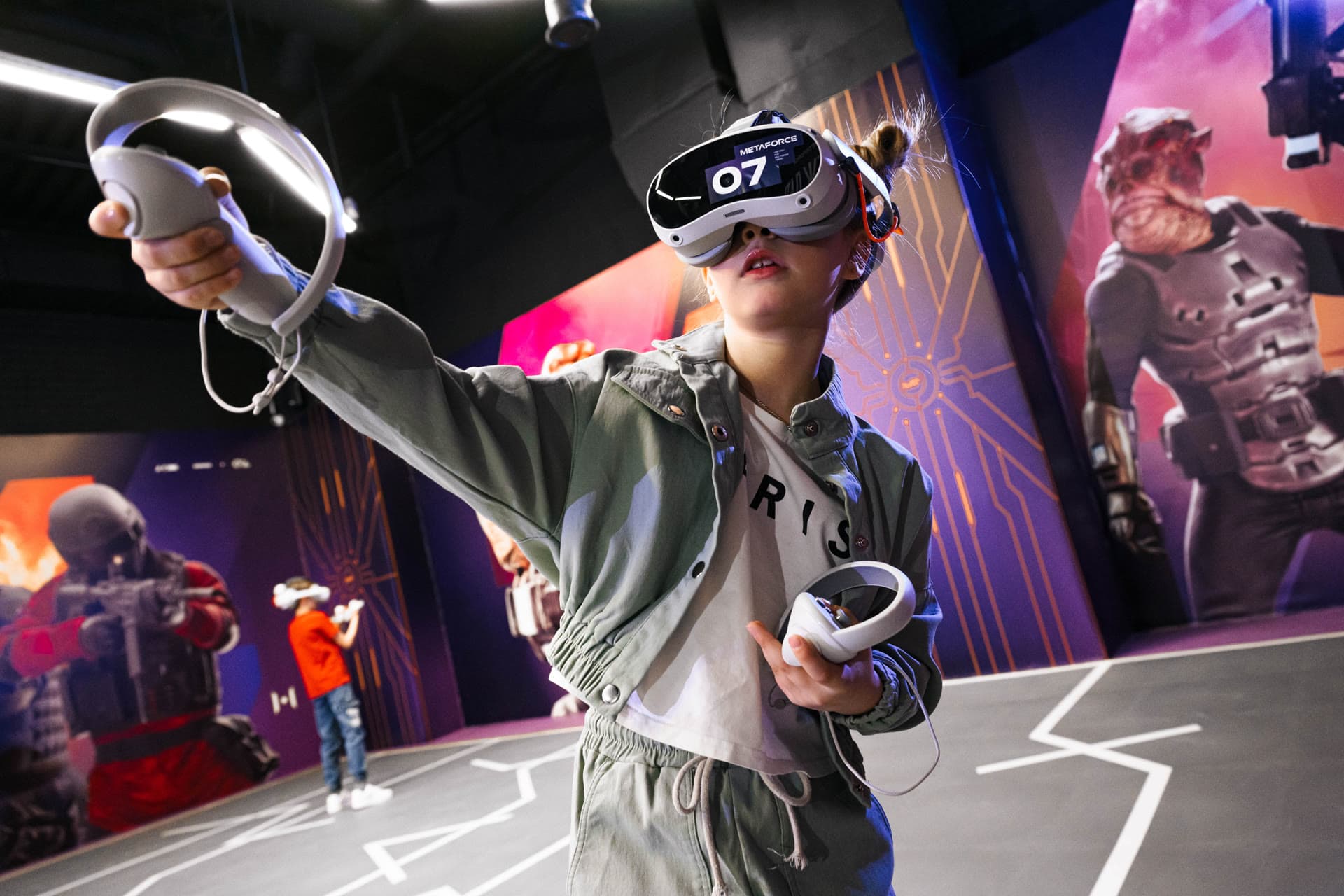
If you already run classic laser tag in a family entertainment center, you have three options: keep it, convert the space to a free-roam VR arena, or run both and sell VR as the premium tier. The right choice depends less on which format is "better" and more on your space, your audience and how often your regulars come back. This guide walks an FEC owner through that decision, including what a conversion involves and how to price two formats side by side.
The format-by-format comparison (equipment, space, ages, hygiene, content updates) is on our VR laser tag page. This article starts where that page ends: you know the differences, and now you have to decide what to do with the laser tag arena you already own.
What problem are you actually trying to solve?
Before comparing formats, name the problem. Most FEC owners who consider VR have one of these:
| Problem | What it looks like | Does VR address it? |
|---|---|---|
| Regulars stopped coming | Party bookings hold, but repeat groups drop off | Yes: new maps or games every 6 months change what players see without a rebuild |
| No teenagers and adults | Laser tag is seen as a kids' party activity | Often: team VR shooters attract teenagers, friend groups and companies |
| Quiet weekdays | Weekends full, Monday to Thursday empty | Partly: corporate events fill weekday evenings, but they have to be sold |
| The maze is worn out | The arena needs a costly rebuild anyway | Yes: a VR arena needs an open, level floor, not walls and theming |
| Weekend capacity is full | You turn away parties on Saturdays | VR adds capacity only if you add space; converting doesn't add slots |
If your laser tag is full, popular with your audience and in good condition, the honest answer may be to keep it and add VR elsewhere, or not at all.
Option 1: Keep classic laser tag
Classic laser tag is a proven FEC attraction with rugged equipment and a fun that everyone understands. Keeping it makes sense when:
- the arena is in good condition and still books well;
- your audience is mostly children aged 6–12 and their parties;
- you don't have staff who could take on headset care and VR equipment routines;
- you have no space that could host a second attraction.
The risk is slow: the same maze, year after year, gradually loses the regulars who know every corner.
Option 2: Convert the laser tag arena to VR
Conversion means removing the maze and turning the room into an open free-roam arena. It makes sense when the maze needs a rebuild anyway, when you want to move up-market toward teenagers, adults and corporate groups, or when you want content that changes without construction.
What a conversion involves:
- Check the room. A Metaforce arena needs a play area of 50–300 m², ceilings from 2.5 m, a level floor and 10–15 kW of power. Multi-level mazes and ramps don't carry over: the floor must be level.
- Strip the build. Walls, obstacles, theming and special lighting are no longer needed, because the world players see is virtual.
- Keep what works. Reception, the briefing area and party rooms are exactly what a VR arena needs too. In many laser tag venues this part transfers almost unchanged.
- Fit the maps. Metaforce rebuilds its game maps around the exact layout of your room, so columns or fixed walls you can't remove are built into the virtual map instead of blocking the conversion.
- Buy equipment. Headsets, computers and tracking can be bought from any supplier.
- Retrain staff. Laser tag marshals become game masters: fitting headsets, running sessions, watching players and cleaning equipment between groups. Metaforce provides staff training and a knowledge base that includes equipment setup and headset care.
The trade-off: during the conversion the room earns nothing, and you lose the audience that specifically wants physical laser tag. Plan the timing away from your peak season.
Option 3: Run both and sell VR as the premium tier
If you have the space, running both formats is often the strongest position. They share reception, briefing and party rooms, and they serve different needs:
- Classic laser tag as the familiar, entry-level option, especially for younger children's parties.
- VR as the upgrade: a different world, new maps twice a year, and a format that teenagers and adults take seriously.
This creates a natural price ladder for parties and groups:
| Tier | What the group gets | Who buys it |
|---|---|---|
| Entry | Classic laser tag package | Younger children's parties, price-sensitive groups |
| Upgrade | VR arena package | Older children, teenagers, adult birthdays |
| Top | Combined package: laser tag plus VR | Large parties, corporate events, groups that want a longer event |
A combined package also solves a scheduling problem: a large group can split, with half in laser tag and half in VR, then swap. On one Metaforce arena 8 to 12 or more play at once, depending on the venue size, so two attractions together handle bigger groups than either alone.
Will VR cannibalize laser tag?
Some of it, yes. A share of guests who would have played laser tag will choose VR instead. The question is whether total revenue per group grows. It tends to when:
- VR is priced above laser tag, so a guest who switches pays more;
- combined packages raise the value of each party;
- VR brings groups who would not have come for laser tag at all: teenagers, adult friend groups and companies.
Watch the numbers in the first months: total party revenue, average group size and the share of combined packages. If VR only moves the same guests from one room to another at the same price, revise the pricing.
Which VR games replace the laser tag experience?
Metaforce has four team shooters that work as VR laser tag, each with its own mechanics, plus content for younger children:
- TeamForce (10 maps): tactical team battle with cover, the closest to classic laser tag.
- StarForce (4 maps) and Portals (3 maps): fast arcade action with teleports and portals.
- Elevators (2 maps): multi-level fights that move between floors, in a virtual building on a flat floor.
- Mini Games (3 games, 6+): for younger children in mixed-age parties.
- Zombies (3 maps, 4–10 players, 9+): co-op survival, coming soon.
The shooters are 7+. Players walk physically and their in-game movement matches real movement, so motion sickness is less common than in joystick-based VR, though it can't be ruled out for everyone. More on the titles is on TeamForce and VR games for arcades.
What does VR cost an FEC that already has laser tag?
Because an FEC already has the venue, reception and party rooms, the main new costs are equipment, any renovation of the room and the content. Metaforce works by subscription instead of a franchise royalty:
| Term | Price (taxes included, paid upfront) |
|---|---|
| 6 months | $4,990 |
| 12 months (most popular) | $7,990 |
| 24 months | $14,990 |
| After the term | Another fixed term, or $799 per month |
There is no franchise fee, no revenue share, no marketing fee and no penalties. The subscription includes games adapted to your layout, launch support, staff training, a manager, a knowledge base and new maps or games every 6 months. With the franchise package, partners also get a website, the network CRM and a marketing kit. When the subscription ends, access to the games stops. The arena can also run under your FEC's own brand: 10 of the roughly 30 arenas in our network do. See franchise cost and how VR fits a wider attraction mix on family entertainment center.
How to decide
- Write down the problem you want to solve, from the table above.
- Measure your room against the requirements: level floor, ceilings from 2.5 m, 10–15 kW, 50–300 m² of play area.
- Decide whether you need laser tag's audience to stay. If yes, look for space to run both.
- Draft a price ladder before you commit, so VR raises revenue per group rather than splitting it.
- Send us your floor plan. We will tell you what fits and how the maps would be laid out.
Related articles
- Free-Roam VR vs VR Arcade Booths: Which Format Earns More per Square Meter?
- How to Choose a Location for a VR Arena: Mall, FEC or Standalone Venue
- Kids' VR Content for Arenas: Age Limits, Safety and Mini Games
FAQ
Can a classic laser tag arena be converted to VR?
Often, yes, if the room has a level floor, ceilings from 2.5 m, 10–15 kW of power and a play area of 50–300 m². Multi-level mazes and ramps don't carry over.
Should I replace laser tag or add VR next to it?
If you have the space and laser tag still books well, running both and selling VR as the premium tier usually keeps both audiences. Conversion makes more sense when the maze needs a rebuild anyway.
Will VR take customers away from my laser tag?
Some, yes. Price VR above laser tag and offer combined packages, so that a guest who switches raises revenue per group.
Can my laser tag staff run a VR arena?
Yes, with training. Metaforce provides staff training and a knowledge base on equipment setup, staff routines and headset care.
Can the VR arena carry my FEC's brand?
Yes. 10 of the roughly 30 arenas in the Metaforce network run the games under their own brand.