
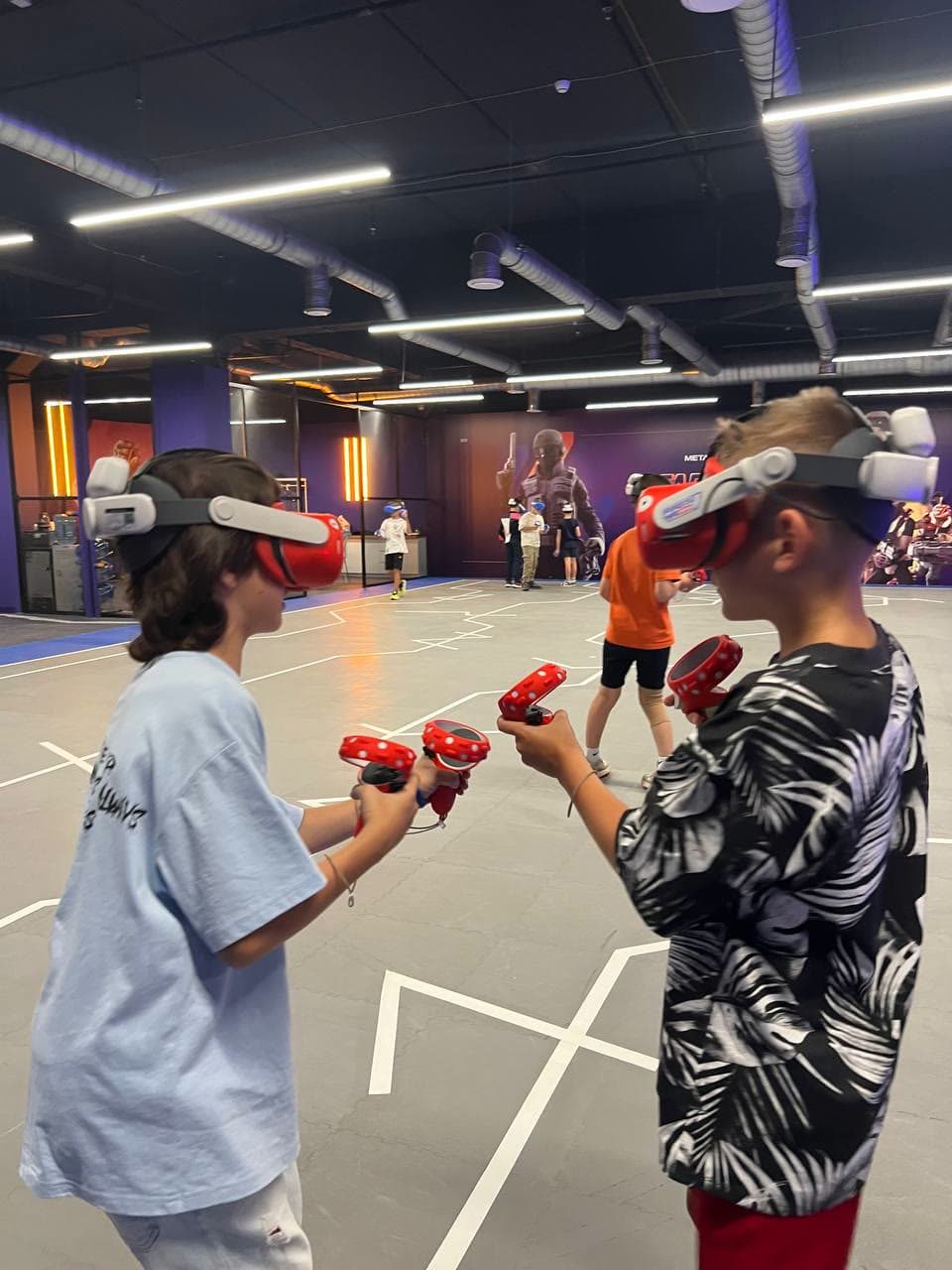
VR laser tag is a team shooting game played in a free-roam virtual reality arena: players wear headsets instead of vests, run around a real open space and fight in a virtual world that can change from a city block to a space station. For an FEC owner, the main difference from classic laser tag is content: a physical maze stays the same for years, while a VR arena gets new maps through software. Metaforce VR Arena supplies team VR games like this for a flat subscription with no royalties.
What is VR laser tag?
The term is used loosely. In a free-roam VR arena game like Metaforce's TeamForce, two squads take cover, run and shoot at each other, much like a laser tag round. The difference is what players see: instead of a dark room with neon walls, each player sees a virtual map built around the exact layout of your arena. Players move physically, and their movement in the game matches their real movement.
Metaforce has four team shooters that work as a VR laser tag game, each with its own mechanics:
| Game | What makes it different | Maps | Age |
|---|---|---|---|
| TeamForce | Tactical team battle with cover, the closest to classic laser tag | 10 | 7+ |
| StarForce | Space setting with teleports between platforms | 4 | 7+ |
| Elevators | Multi-level fight that moves between floors | 2 | 7+ |
| Portals | Arcade action with portals and surprise flanks | 3 | 7+ |
On top of that, Mini Games (6+) cover younger children, and Zombies, a co-op survival game (9+), is coming soon. See all titles in VR games for arcades.
How does VR laser tag compare with classic laser tag?
Classic laser tag uses infrared guns and sensor vests in a physical arena with walls, obstacles, special lighting and often fog. It is a proven FEC attraction with a long history. Here is how the two formats compare from an operator's point of view:
| Classic laser tag | VR arena laser tag (Metaforce) | |
|---|---|---|
| What players see | The real room: walls, obstacles, lighting effects | A virtual world mapped onto your real space |
| Changing the experience | Rebuild or redecorate the physical arena | New maps or games every 6 months, delivered as software |
| Variety in one arena | One maze, different game modes | 5 games, 19 shooter maps plus 3 family mini games |
| Space | Usually large, multi-level mazes are common | Play area 50–300 m², optimal 100–150 m² |
| Arena build | Walls, obstacles, theming, lighting | Open, level floor; maps adapted to your layout |
| Equipment | Guns, vests, charging, scoring system | Headsets, computers, tracking |
| Players | Varies by system and arena | 4–20 per game; 8 to 12 or more at once on one arena |
| Main ages | Children and teenagers, also groups | 6+ (Mini Games), 7+ shooters |
| Hygiene routine | Vest and gun cleaning | Headset cleaning and care |
Neither format is right for every venue. Classic laser tag has simple, rugged equipment and a familiar brand of fun. VR needs more careful equipment handling, but gives returning guests a new world to play in without rebuilding the room.
Why are FEC owners adding VR laser tag?
Repeat visits. The biggest weakness of any physical attraction is that regulars learn it. In a VR arena, a new map is a new arena for the player. Metaforce adds new maps or games every 6 months at no extra cost.
Older audience. Team VR shooters attract teenagers, friend groups and corporate clients who may see classic laser tag as a kids' party. That helps fill weekday evenings with arena rentals and team building. See VR team building.
Less build-out. A Metaforce arena needs a level floor, ceilings from 2.5 m and 10–15 kW of power. The game world is virtual, so you don't need to theme the room. If the room has columns or fixed walls, we rebuild the maps around them. Layout guidance is in VR arena design.
One space, many products. The same arena runs a 6-year-old's party with Mini Games in the morning and a corporate TeamForce tournament in the evening.
Can I convert a classic laser tag arena to VR?
Often, yes, if the space meets the requirements. Check:
| Requirement | Metaforce |
|---|---|
| Play area | 50–300 m² |
| Total venue, including reception and lounge | 100–700 m² |
| Floor | Level (multi-level mazes and ramps don't fit a free-roam arena) |
| Ceiling height | From 2.5 m |
| Power | 10–15 kW |
A laser tag venue already has a reception, a briefing area and party rooms, which a VR arena needs too. Send us the floor plan and we'll tell you what has to change. You can also keep both attractions side by side and sell VR as the premium option.
Laser tag business vs VR laser tag: what it takes to start
If you are researching how to start a laser tag business, most of the budget goes into the room. Industry guides describe a classic arena like this (guide estimates for 2026, not franchisor data):
| Classic laser tag (industry guides) | VR laser tag (Metaforce) | |
|---|---|---|
| Startup cost | About $150,000 to $500,000 or more [1]; $100,000–$250,000 for a mid-range arena, $150,000–$400,000+ for a flagship [2] | Room, renovation and equipment, plus a subscription from $4,990 for 6 months |
| Space | 5,000–10,000 sq ft [1] | Play area 50–300 m² (538–3,229 sq ft) |
| Ceiling | At least 14 ft, 18–20 ft for multi-level [1] | From 2.5 m (8.2 ft) |
| Arena build | Construction and theming $35–$85 per sq ft [2] | Open, level floor; no walls or theming |
| Equipment | $2,500–$3,500 per player station [2] | Headsets, computers, tracking, bought by the operator |
| New experience | Rebuild or redecorate the maze | New maps or games every 6 months, by update |
The key difference for a laser tag arena cost plan is what happens after opening. A physical maze is a one-time build that regulars learn; changing it means another renovation. In a VR arena the maze is software: Metaforce rebuilds its maps around your room's exact layout and ships new maps or games every 6 months as part of the subscription, with no construction.
On franchises. When we checked in October 2026, we found no current US laser tag franchise with a public franchise disclosure document (FDD), which is why the figures above come from guides. Metaforce isn't a laser tag franchise either: it is a subscription to VR games and know-how, with no franchise fee and no royalty.
For a decision guide on keeping, converting or adding to an existing arena, see Laser tag or VR? Keep, convert or add.
How does a VR arena earn money?
The same products you sell for laser tag work for VR:
- hourly play per player;
- whole-arena rental;
- birthday party packages (VR birthday party);
- corporate events and team building;
- 12-month gift certificates sold online (with the franchise package).
As an illustration, in our Russian arenas 1 hour per player costs from about RUB 800 to RUB 2,300, and the whole arena costs about RUB 5,500–19,900 per hour. Metaforce arenas in Russia make RUB 500,000–1,500,000 a month depending on the city, the venue and occupancy, with payback from about one year.
Is there a VR laser tag franchise without royalties?
Metaforce works by subscription, not a classic franchise with royalties:
| Term | Price (taxes included, paid upfront) |
|---|---|
| 6 months | $4,990 |
| 12 months (most popular) | $7,990 |
| 24 months | $14,990 |
| After the term | Another fixed term, or $799 per month |
There is no franchise fee, no revenue share, no marketing fee and no penalties. Equipment can be bought from any supplier; you pay for the venue, renovation and equipment separately. When the subscription ends, access to the games stops. The subscription includes games adapted to your venue, launch support, staff training, a manager, a knowledge base, a website, the network CRM and a marketing kit. Details are on franchise cost and no-royalty franchise.
About 30 arenas in Russia, Kazakhstan, Israel and Slovakia run Metaforce games today.
FAQ
Is VR laser tag safe for children?
Mini Games are designed for kids from 6, and the shooters are for 7+. Players walk physically and in-game movement matches real movement, so motion sickness is less common than in joystick-based VR, though it can't be ruled out for everyone.
Does VR laser tag need a dark, themed arena?
No. The world players see is virtual. The arena needs a level floor, ceilings from 2.5 m, 10–15 kW of power and a play area of 50–300 m².
How many players fit in one VR laser tag game?
A Metaforce game supports 4–20 players. On one arena 8 to 12 or more play at once, depending on the venue size.
Can I run VR and classic laser tag in the same FEC?
Yes. They share reception, briefing and party rooms, and VR can be sold as the premium option for older kids, teenagers and adults.
How often does the content change?
New maps or games are released every 6 months and are included in the subscription.
Sources
Checked October 2026. Industry guide estimates, not franchise disclosure data; costs vary by market and build.
- ZenBusiness, laser tag arena startup guide (industry guide, updated 7 October 2026): https://www.zenbusiness.com/start-a-business/entertainment/laser-tag-arena/
- ROLLER, laser tag business guide (venue software vendor, updated 5 June 2026): https://www.roller.software/blog/laser-tag-business