
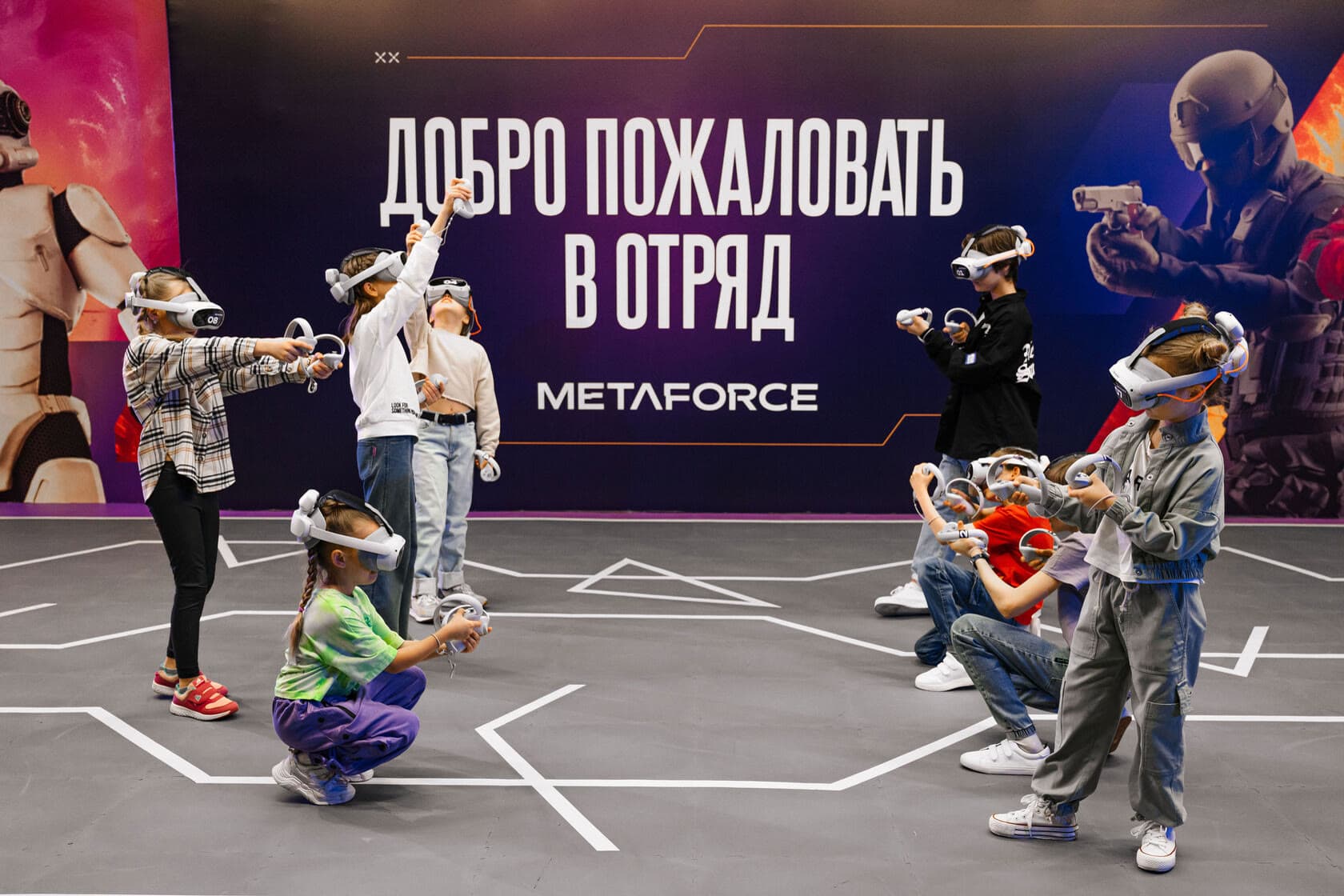
Kids' VR content for arenas has to work on three levels: content that suits the age, an age policy the operator can defend, and staff routines that keep young players safe. In the Metaforce VR Arena line-up, Mini Games is rated 6+, shooters 7+ and the upcoming Zombies 9+, and the arenas admit players from age 6.
This article is written for arena operators and venue owners. It explains how to set age limits, how to read the headset manufacturers' guidance and what to build into daily operations.
Why does kids' content matter for an arena business?
Children's birthday parties and family visits are among the core formats a VR arena sells, together with hourly play, whole-arena rental, corporate events and gift certificates. A line-up made only of shooters limits that market: some parents won't book a shooter for a seven-year-old, and some groups simply want something calmer.
Kid-friendly content does three things for the operator:
- Opens younger birthday parties. Simple rules mean every child joins in from the first minute.
- Serves mixed groups. Parents and children can play together on equal terms.
- Builds future regulars. A child who starts with family games often moves to team shooters a few years later.
How birthday parties turn into revenue is covered on the VR birthday party page. This article focuses on age limits and safety.
What age limits do Metaforce games have?
Each Metaforce game has its own content rating, based on the type of action and how complex it is to play:
| Game | Format | Age rating |
|---|---|---|
| Mini Games | 3 short, non-violent games for kids and families | 6+ |
| TeamForce | Tactical team shooter | 7+ |
| StarForce | Space shooter with teleports | 7+ |
| Elevators | Multi-level shooter | 7+ |
| Portals | Arcade shooter with portals | 7+ |
| Zombies (coming soon) | Co-op survival, high difficulty | 9+ |
Metaforce arenas admit players from 6. For the youngest guests that means Mini Games. From 7, children can play the shooters, and Zombies, with its higher difficulty and theme, is aimed at 9 and up.
These are content ratings. They describe what happens in the game, not whether a particular headset is approved for a child of that age. That is a separate question.
What do headset manufacturers say about children?
Consumer headset makers publish their own age guidance, and it is often higher than the content ratings above. As of October 2026, the public guidance says:
| Manufacturer | Published guidance |
|---|---|
| Meta (Quest) | A Meta account is needed; children aged 10–12 can use Meta Quest 2 and 3 through a parent-managed account; children under 10 cannot use Meta Quest 2 and 3; on Meta's other headsets, where parent-managed accounts are not available, children under 13 cannot use them. Ages may vary by country. |
| Sony (PlayStation VR2) | Not for use by children under 12. |
| PICO (PICO 4) | The Safety & Warranty Guide says the product is not recommended for children aged 12 and under. |
Sources are listed at the end of this article. Guidance changes, so always check the current documents for the exact model you buy.
What this means for an operator:
- Your hardware choice affects your age policy. Metaforce partners buy headsets, computers and tracking from any supplier. Before you buy, read the manufacturer's safety documentation for the model, including any age guidance and supervision requirements. The VR arena equipment guide covers how to choose hardware.
- Write your age policy down. Minimum age, which games are allowed at which age, whether a parent must be present, and how staff check age at booking and at the door.
- Check local rules and insurance. Requirements for children's entertainment differ by country and city. Agree the policy with your insurer and local advisers before you open.
- Get consent. A parent or guardian should confirm the child's age and accept the safety rules before the session.
Is free-roam VR easier on children than seated VR?
In free-roam VR, players walk and run for real. Movement in the game matches movement in the room, so the eyes and the body get the same signal. Motion sickness is less common than with joystick locomotion, where the picture moves while the body stands still.
Less common does not mean impossible. Any guest, child or adult, can feel unwell, tired or dizzy. Staff need to spot the signs early and pause a player without fuss. The free-roam VR page explains the format in more detail.
What safety routines should staff follow with kids?
Good content is half the job. The other half is how the session is run. A practical checklist for sessions with children:
Before the session
- Confirm ages for the whole group at booking and pick the games accordingly.
- Ask the parent or organizer about health conditions that the headset manufacturer lists as a reason not to use VR.
- Run a short, clear briefing: how to move, what the play-area boundaries look like in the game, what to do if they feel unwell.
- Fit the headset properly. Loose straps on small heads are a common cause of discomfort.
During the session
- Keep a staff member watching the arena at all times, not only the screens.
- Watch for signs of discomfort: stopping, holding the headset, unsteady movement.
- Keep sessions and breaks reasonable. Manufacturers' guides often recommend regular breaks.
- Pause the game immediately if a player looks unwell, then help them take off the headset and sit down in the lounge.
After the session
- Clean headsets and controllers between groups.
- Note any incidents, even small ones, so the team can learn from them.
The Metaforce knowledge base covers equipment setup, headset care and staff routines, and partners receive staff training as part of launch support.
How do you build a kids' offer around Mini Games?
Mini Games is a collection of 3 short, non-violent games set in bright worlds. Players race, catch creatures with a net and compete in accuracy and speed. A game takes 4 to 20 players, in free-for-all or team mode. More on the Mini Games page.
Ways operators use it:
- Birthday packages for ages 6–7. A whole party on Mini Games, with a lounge for cake and presents.
- Mixed parties. Younger children on Mini Games, older ones moving to a shooter later in the session.
- Family play. Parents and kids in the same game.
- A calmer break. Between shooter rounds for groups that want variety.
A Metaforce arena admits from 6, and the line-up gives the operator a natural path as children grow: Mini Games at 6, shooters at 7, Zombies at 9. New maps or games arrive every 6 months and are included in the subscription.
How do you talk to parents about safety?
Your marketing and booking staff will hear the same questions from parents again and again. Prepare short, honest answers:
- What age is each game for, and why.
- What the staff do during the session.
- That motion sickness is less common in free-roam, but that staff will pause the game if a child feels unwell.
- What the rules are for parents: can they watch, can they play together.
Keep it factual and avoid promises like "completely safe" or "no motion sickness". Clear rules build more trust than big claims.
How does this fit a family entertainment center?
Many Metaforce arenas sit in shopping malls and family entertainment centers, where families with children are a large share of the traffic. A clear age policy and a kid-friendly game make a VR arena easier to place next to other family attractions. See the family entertainment center page for how a VR arena fits an FEC.
The subscription costs from $4,990 for 6 months, taxes included, with no franchise fee and no royalties. Details are on the franchise cost page.
Related articles
- Birthday Parties as a Key Revenue Line of a VR Arena: an Operator's View
- How Often Should a VR Arena Update Its Games? An Operator's Guide
- Staff for a VR Arena: Roles, Training and a Knowledge Base
FAQ
From what age do Metaforce arenas admit players?
From 6. At that age guests play Mini Games; the shooters are rated 7+ and Zombies 9+.
Do content ratings replace the headset manufacturer's guidance?
No. Content ratings describe the game. Headset makers publish their own age guidance, which is often higher. Read the documentation for the model you buy and set your age policy with local rules and your insurer in mind.
Does free-roam VR cause motion sickness in children?
It is less common than in joystick-based VR, because movement in the game matches real movement. It can still happen, so staff should watch players and pause the game for anyone who feels unwell.
Is Mini Games violent?
No. It is a collection of 3 non-violent games for kids and families, rated 6+.
Does Metaforce train staff to work with children?
Partners get launch support and staff training, and the knowledge base covers staff routines, equipment setup and headset care.
Sources
Checked October 2026.
- Meta, "Meta Quest Safety Information for Parents and Children": https://www.meta.com/quest/parent-info/
- Meta Help Center, "Create and manage a Meta account on Meta Horizon for your child": https://www.meta.com/help/quest/602330541813401/
- Sony Interactive Entertainment, PlayStation VR2 Instruction Manual (health and safety warning): https://www.playstation.com/content/dam/global_pdc/en/corporate/support/manuals/psvr2-docs/EN_FR_AMER_CFI-ZVR1_PS%20VR2_Instruction_Manual_Web.pdf
- Sony Interactive Entertainment, health warning: https://www.playstation.com/en-mt/legal/health-warning/
- PICO, Safety & Warranty Guide for PICO 4 Series (PDF linked from the official Health and Safety Warnings page): https://www.picoxr.com/global/legal/health-and-safety-warnings