
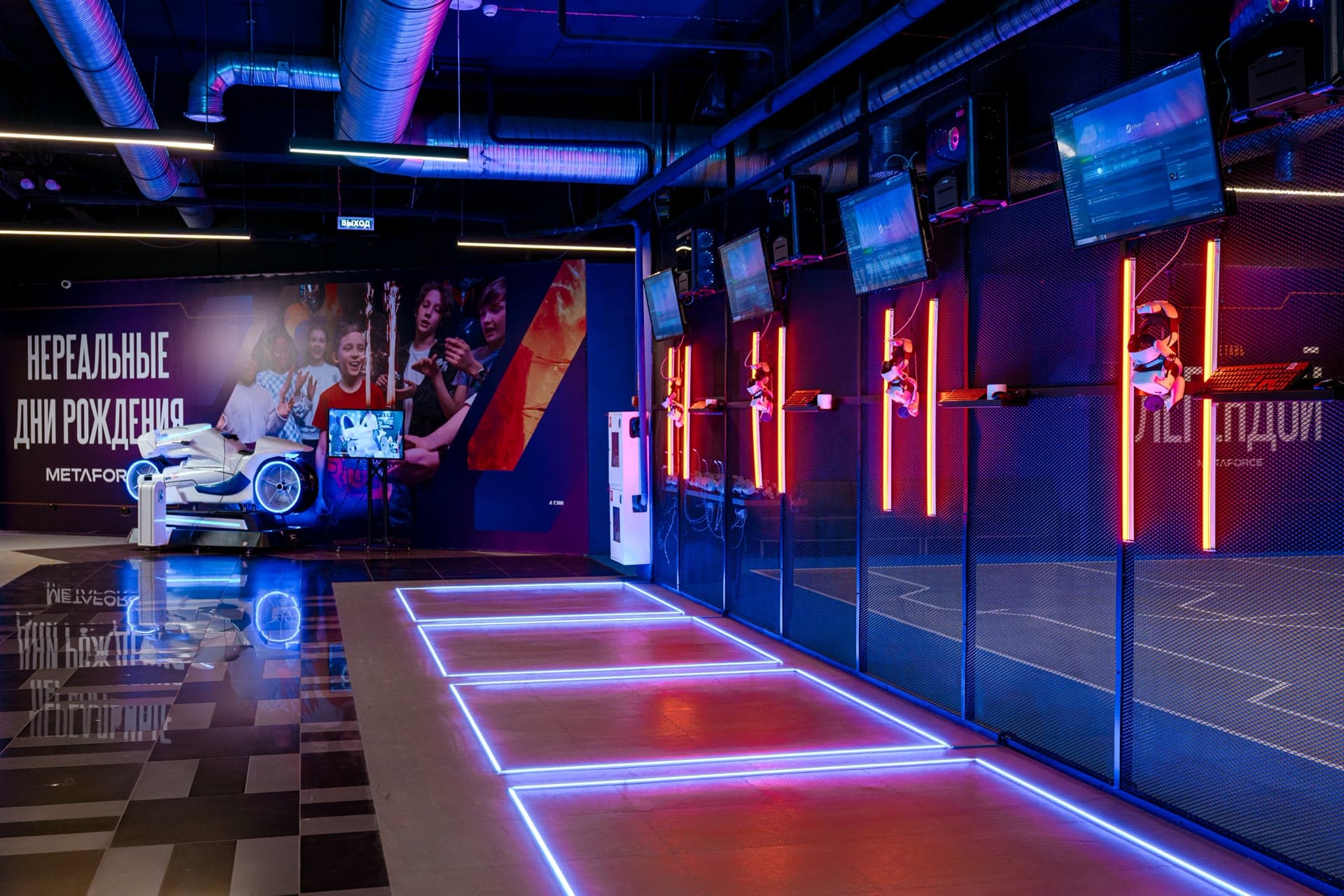
The best VR arena location is the one where your rent matches the way you plan to sell. A shopping mall gives you foot traffic and an easy meeting point but charges for it; a family entertainment center (FEC) gives you a ready audience of families and groups; a standalone venue usually costs less per square meter but relies entirely on bookings and your own marketing. In the Metaforce VR Arena network, many arenas operate in shopping malls, while some, for example in Tyumen and Perm, run in standalone premises.
This article compares the three options, shows how to score a specific unit and lists the technical checks that rule a site in or out. Venue size and layout are covered separately in the VR arena design guide.
What does a free-roam arena need from any location?
Before comparing location types, filter out units that can't host an arena at all. A Metaforce arena needs:
| Parameter | Requirement |
|---|---|
| Play area | 50–300 m² |
| Total venue | 100–700 m² |
| Optimal format | 150–250 m² total with a 100–150 m² play area |
| Power | 10–15 kW |
| Floor | Level |
| Ceiling height | From 2.5 m |
Two things are more flexible than people expect. First, the shape of the unit: Metaforce rebuilds its game maps around the exact layout of each venue, so columns or an L-shaped hall don't automatically rule a site out. Second, the size of the city: the network works in cities from 20,000 residents.
Mall, FEC or standalone: what are the trade-offs?
| Shopping mall | Family entertainment center | Standalone venue | |
|---|---|---|---|
| Where guests come from | Foot traffic plus planned visits | The FEC's own visitors, mostly families and groups | Planned visits only |
| Rent per m² | Usually the highest | Depends on the deal with the FEC operator | Usually the lowest |
| Visibility | High, if the unit is well placed | High inside the center | Low; signage and online presence do the work |
| Opening hours | Set by the mall | Set by the FEC | Your own |
| Neighbors and noise | Needs an entertainment zone | Natural fit | Depends on the building |
| Parking, food, restrooms | Provided by the mall | Provided by the FEC | Your responsibility |
| Main risk | Rent and dependence on the mall's footfall | Sharing an audience with other attractions | Slower ramp-up without walk-ins |
Shopping mall
A mall is the most common choice in the Metaforce network. Arenas operate in MEGA Khimki and MEGA Belaya Dacha in the Moscow region, Kalita and Stolitsa in Moscow, Torgovy Kvartal in Domodedovo, Fan Fan and Greenwich in Yekaterinburg, Goodwin in Tyumen, Arteria in Ufa, Manufaktura in Rostov-on-Don, MEGA Aksay and Kreiser in Vladimir, among others.
Why malls work:
- Groups combine the visit. Families eat at the food court, teenagers meet at the cinema, parents shop while a party plays.
- Visibility sells. People walking past see the arena and come back for a party or an event.
- Infrastructure is ready. Parking, restrooms, security and food are already there.
What to watch:
- Rent. Mall rent per m² is usually the highest of the three options, so an oversized unit hurts more here.
- Position inside the mall. In our network, arenas work on floors from the lower ground floor of Arteria in Ufa to the fourth floor of Fan Fan in Yekaterinburg. The floor number matters less than footfall past the unit and how easy it is to find. Near the cinema, food court or kids' zones works well.
- Hours. Arenas in malls usually open from 10:00 to 22:00, some until 23:00. Late corporate events may need the mall's agreement.
- Noise. Players run and shout. An entertainment cluster is a better neighbor than quiet stores.
- Fit-out period. Renovation takes weeks with no revenue. A rent-free fit-out period is a normal point of negotiation.
More on working with malls is on the VR for shopping malls page.
Family entertainment center
For an FEC owner, a VR arena is an attraction added to an existing business rather than a separate destination. A partner arena running Metaforce games already operates inside a family entertainment center in Voronezh, and the fit is natural: the FEC already attracts the audience an arena sells to, families with children, teenage groups and birthday parties.
What works in an FEC:
- Shared traffic. Guests who came for one attraction try another.
- Combined packages. A birthday party can include VR rounds alongside the FEC's other activities, which raises the average check for the whole venue.
- Shared staff and infrastructure. Reception, cafe, restrooms and the party rooms are already there.
- Content for all ages. Metaforce shooters are 7+, and Mini Games are designed for kids and families from 6+, which suits an FEC's audience.
What to watch:
- Space inside the FEC. The arena needs an open, level play area and 10–15 kW of power. Converting part of an existing hall may mean moving other attractions.
- Internal competition. The arena competes for time and budget with other attractions. Pricing and packages need to work for the whole venue, not just one zone.
- Who operates it. If the FEC owner runs the arena, it's one business. If a separate operator rents space, agree on how parties and shared areas are handled.
Our family entertainment center page covers how a VR arena fits into an FEC's mix.
Standalone venue
Some Metaforce arenas, for example in Tyumen and Perm, operate in standalone premises rather than malls. A standalone venue is usually chosen for lower rent per square meter, more control over hours and layout, and the freedom to run events without fitting in with a mall's rules.
What works in a standalone venue:
- Lower fixed costs. Lower rent means the arena breaks even at a lower occupancy.
- Your own hours. Late corporate events and early parties are easier to arrange.
- More space for the money. A larger lounge for parties and corporate events.
What to watch:
- No walk-ins. Every guest has to find you. Your website, maps listings, reviews and local advertising do the work that a mall corridor does elsewhere. The website and marketing kit that come with the Metaforce franchise package help, but local promotion is the operator's job.
- Access. Parking, public transport and a clear entrance matter more when guests come specifically for you.
- Infrastructure. Restrooms, ventilation, fire exits and power are your responsibility to arrange with the landlord.
- Ramp-up time. Without walk-in traffic, bookings take longer to build. Plan more working capital.
How do you score a specific unit?
Location types are only a starting point. Two mall units in the same city can differ more than a mall and a standalone venue. Score each candidate on the same criteria, from 1 (poor) to 5 (strong):
| Criterion | What to check | Score |
|---|---|---|
| Technical fit | Play area, total area, 10–15 kW on paper, level floor, ceilings from 2.5 m | |
| Rent vs capacity | Monthly rent per player slot you can run at once | |
| Catchment | Population and audience within reach; the network works in cities from 20,000 residents | |
| Visibility and access | Footfall past the unit, signage, parking, transport | |
| Neighbors | Cinema, food court, kids' zones, FEC attractions vs quiet tenants | |
| Hours | Evenings and weekends available, late events possible | |
| Group logistics | Room for a lounge, nearby food, easy meeting point | |
| Lease terms | Fit-out period, term, indexation, exit conditions |
Weight the criteria to match your sales plan. If you expect most revenue from birthdays and corporate events booked in advance, rent and group logistics matter more than visibility. If you count on walk-in sessions, visibility and footfall come first.
What should you check before signing the lease?
- Power allocation in writing. 10–15 kW for the unit, or a confirmed upgrade.
- Floor condition. Leveling can be one of the larger renovation costs.
- Ventilation. A full arena of active players needs fresh, cool air.
- Network. A stable dedicated connection; check you can bring your own line.
- Noise rules. Who your neighbors are and what they will tolerate.
- Fire safety and exits. Requirements depend on the building and local rules.
- Fit-out period and opening date. Every week of renovation without rent relief adds to the launch budget.
Send the floor plan to our manager before you sign: we will tell you whether the unit fits and how the maps can be built around it. We also receive rental offers for venues in different cities and can share suitable ones with partners. The budget side of the decision is covered in how much it costs to open a VR arcade and on the VR franchise cost page.
Related articles
- VR Arena in a Shopping Mall: What Mall Owners Gain in Traffic and Dwell Time
- Can a VR Arena Work in a City of 20,000–100,000 People?
- Turnkey VR Arena Checklist: From Lease to Opening Day
FAQ
Is a shopping mall the best location for a VR arena?
It is the most common one in the Metaforce network, thanks to foot traffic and ready infrastructure. It also has the highest rent, so it is not automatically the best for every arena.
Can a VR arena work outside a mall?
Yes. Some Metaforce arenas, for example in Tyumen and Perm, operate in standalone premises. They rely more on bookings, online presence and local marketing.
Does a VR arena fit inside a family entertainment center?
Its audience, families, teenage groups and birthday parties, matches what an FEC already attracts. The FEC needs an open, level play area, 10–15 kW of power and ceilings from 2.5 m.
Which floor of a mall is best?
Footfall and visibility matter more than the floor number. Metaforce arenas work on floors from lower ground to the fourth.
How big does the city need to be?
The Metaforce network works in cities from 20,000 residents.
Can Metaforce help find a venue?
We review floor plans and receive rental offers in different cities, which we can share with partners looking for a site.
Apply now and send us the units you are considering.