
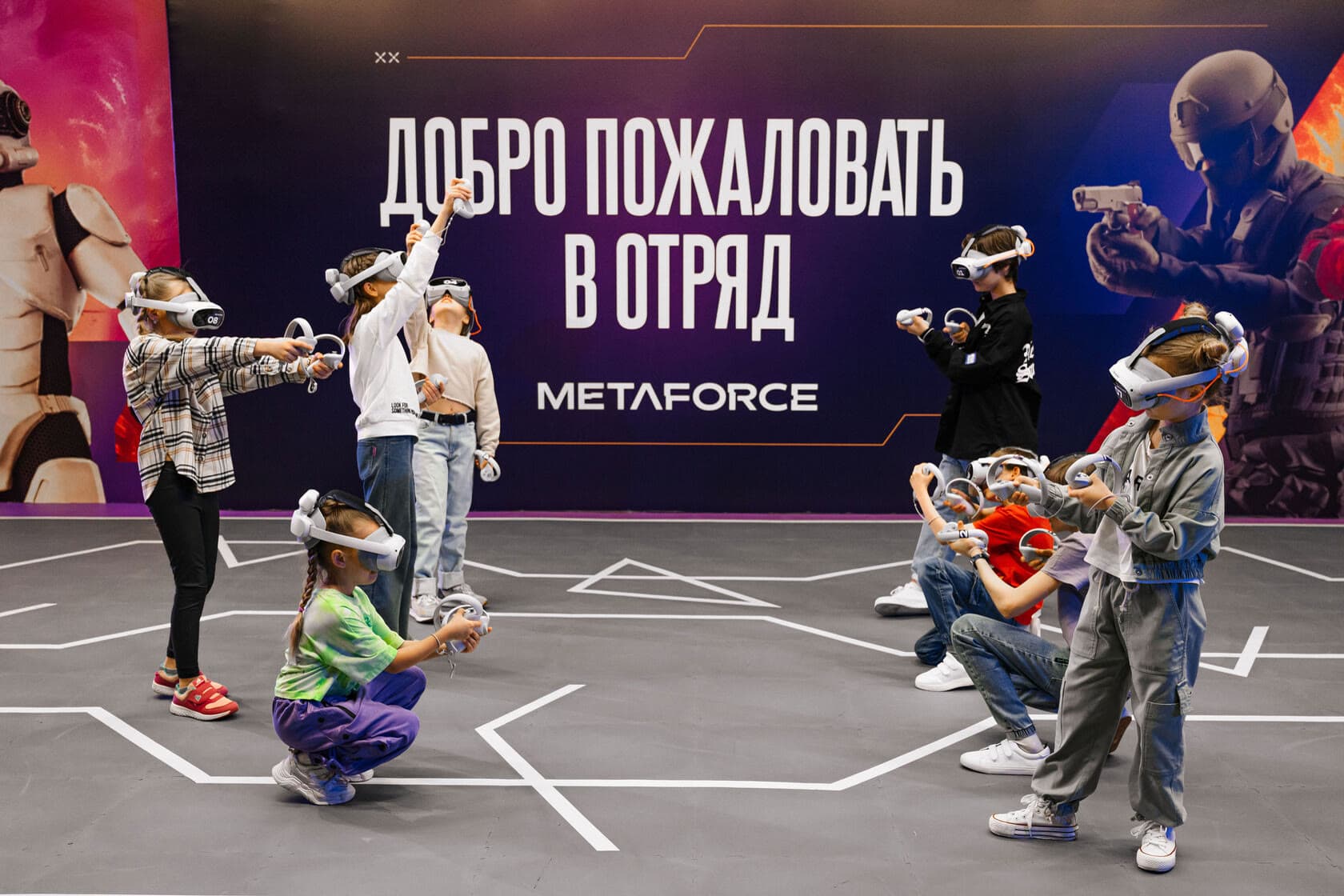
Free roam VR is virtual reality where players walk and run around a real room instead of standing in one spot or moving with a joystick. A group shares one virtual world, sees each other as avatars and plays as a team. Metaforce VR Arena licenses free-roam multiplayer games to venues on a flat subscription, with maps rebuilt around each venue's layout.
What makes free roam VR different from other VR formats?
Most people's first VR experience is a headset at home or a booth in a mall: one player, a small space, movement by thumbstick. Free roam turns that into a group activity in a dedicated space. It belongs to what the industry calls location-based entertainment VR, or LBE VR: experiences people can't easily get at home, sold by venues per session or per group.
| Free-roam arena | VR booth or station | Home VR | |
|---|---|---|---|
| How players move | Walk and run physically across the play area | Stand or turn in place, move with a stick | Mostly in place, move with a stick |
| Players together | A team in one shared world | Usually one per station | Usually one, online with others |
| Space | A dedicated hall; Metaforce play areas are 50–300 m² | A few square meters per station | A living room |
| What a venue sells | Group bookings, parties, team events | Short individual sessions | — |
The key point for a venue owner: a free-roam arena sells an outing for a whole group, not a few minutes of novelty for one person. That changes who books, how far ahead they book and how much each booking is worth.
How does a free roam VR system work?
A free roam VR system has four parts that work together:
- Headsets and controllers for every player in the round.
- Tracking that knows where each player is in the real room and puts them in the same spot in the game, so people see each other and don't walk into one another.
- Computers and network that run the game and keep all players in sync.
- Games built for the space. The virtual map has to match the real room: where the walls are, how much floor there is, where players can run.
The fourth part is the one that often gets overlooked. A game designed for an empty 10 × 10 m square doesn't fit a hall with columns or an L-shaped floor plan. Metaforce rebuilds its maps around the exact layout of each partner venue, so the arena doesn't have to be shaped around the game.
Hardware is bought by the partner from any supplier. Our knowledge base covers equipment setup and headset care; the details are on the VR arena equipment page.
Why does free roam VR sell well to groups?
Because their body does what their character does. When a player ducks behind cover, they really duck. When they run to a flank, they really run. Movement in the game matches movement in the room, and that has two practical effects.
- It feels more real and more social. Teammates are physically next to each other, call out to each other and see each other move. Groups of friends, families and colleagues come for that shared experience.
- Motion sickness is less common. Much of the discomfort in VR comes from the eyes seeing movement the body doesn't feel, which is what happens with joystick locomotion. In free roam that mismatch is smaller. It is less common, not impossible: some people may still feel unwell, and staff should know how to spot it and pause a player.
What free roam VR games does Metaforce offer?
All Metaforce games are developed in-house and made for multiplayer free roam. Each game supports 4 to 20 players; on one arena 8 to 12 or more people play at once, depending on the size of the venue.
| Game | What players do | Maps | Age |
|---|---|---|---|
| TeamForce | Tactical team shooter: two squads, cover, real running | 10 | 7+ |
| StarForce | Space shooter with teleports between platforms | 4 | 7+ |
| Elevators | Multi-level shooter, the fight moves between floors | 2 | 7+ |
| Portals | Arcade shooter with portals and surprise flanks | 3 | 7+ |
| Mini Games | Short, bright games for kids and families | 3 games | 6+ |
| Zombies (coming soon) | Co-op survival, 4–10 players | 3 | 9+ |
New maps or games arrive every 6 months and are included in the subscription. For a free-roam venue this matters more than the size of the launch library: regular guests come back when there is something new to play. See the flagship game on the TeamForce page.
How much space does a free roam VR arena need?
Less than many people expect. A Metaforce free roam VR arena needs:
| Parameter | Requirement |
|---|---|
| Play area | 50–300 m² |
| Total venue | 100–700 m² |
| Optimal format | 150–250 m² total with a 100–150 m² play area |
| Power | 10–15 kW |
| Floor | Level |
| Ceiling height | From 2.5 m |
The total area includes the reception and a lounge where groups wait between rounds and celebrate. A bigger play area lets more people play at once but also raises rent. Our VR arena design guide covers zoning and layout.
Who runs free-roam arenas, and where?
Free roam suits venues that already have, or want, group traffic:
- Family entertainment centers adding an attraction with a strong birthday-party business.
- Shopping malls looking for an entertainment tenant that people visit on purpose. See VR for shopping malls.
- Standalone venues built around bookings: parties, corporate events, friend groups.
- Existing VR arcades that want multiplayer free-roam content alongside booths.
Metaforce games run in about 30 arenas in 4 countries: Russia, Kazakhstan, Israel and Slovakia. Metaforce started in Yekaterinburg, where we run two arenas of our own and test every update on real guests before it reaches partners. The format works in cities from 20,000 residents.
How do you open a free-roam arena with Metaforce?
Metaforce works by subscription, not royalties: $4,990 for 6 months, $7,990 for 12 months or $14,990 for 24 months, then $799 per month, taxes included. There is no franchise fee, no revenue share and no marketing fee. The venue, renovation and equipment are paid by the partner. Full details are on the franchise cost page.
- Send an application and your floor plan.
- Check the venue against the requirements with our manager.
- Choose a subscription term and buy equipment from the supplier you prefer.
- Renovate while we adapt the maps to your layout.
- Train your staff with us and open.
FAQ
What does free roam VR mean?
Players move physically around a real space while wearing headsets, and their movement is reproduced in the game. A group plays together in one shared virtual world instead of standing in separate booths.
How many people can play free roam VR at once?
Each Metaforce game supports 4 to 20 players. On one arena, 8 to 12 or more people play at once, depending on the venue size.
Does free roam VR cause motion sickness?
It is less common than in joystick-based VR, because movement in the game matches real movement. It can still happen to some people, so staff should keep an eye on players and pause the game for anyone who feels unwell.
What is the minimum space for a free roam VR arena?
For Metaforce, the play area starts at 50 m² and the total venue at 100 m². The optimal format is 150–250 m² in total with a 100–150 m² play area, ceilings from 2.5 m and 10–15 kW of power.
Can free roam VR games fit an irregular room?
Yes. Metaforce rebuilds its maps around the exact layout of each venue. Send the floor plan to our manager to check what fits.
Is free roam VR suitable for children?
Metaforce shooters are rated 7+, and Mini Games are made for kids and families from 6+.