
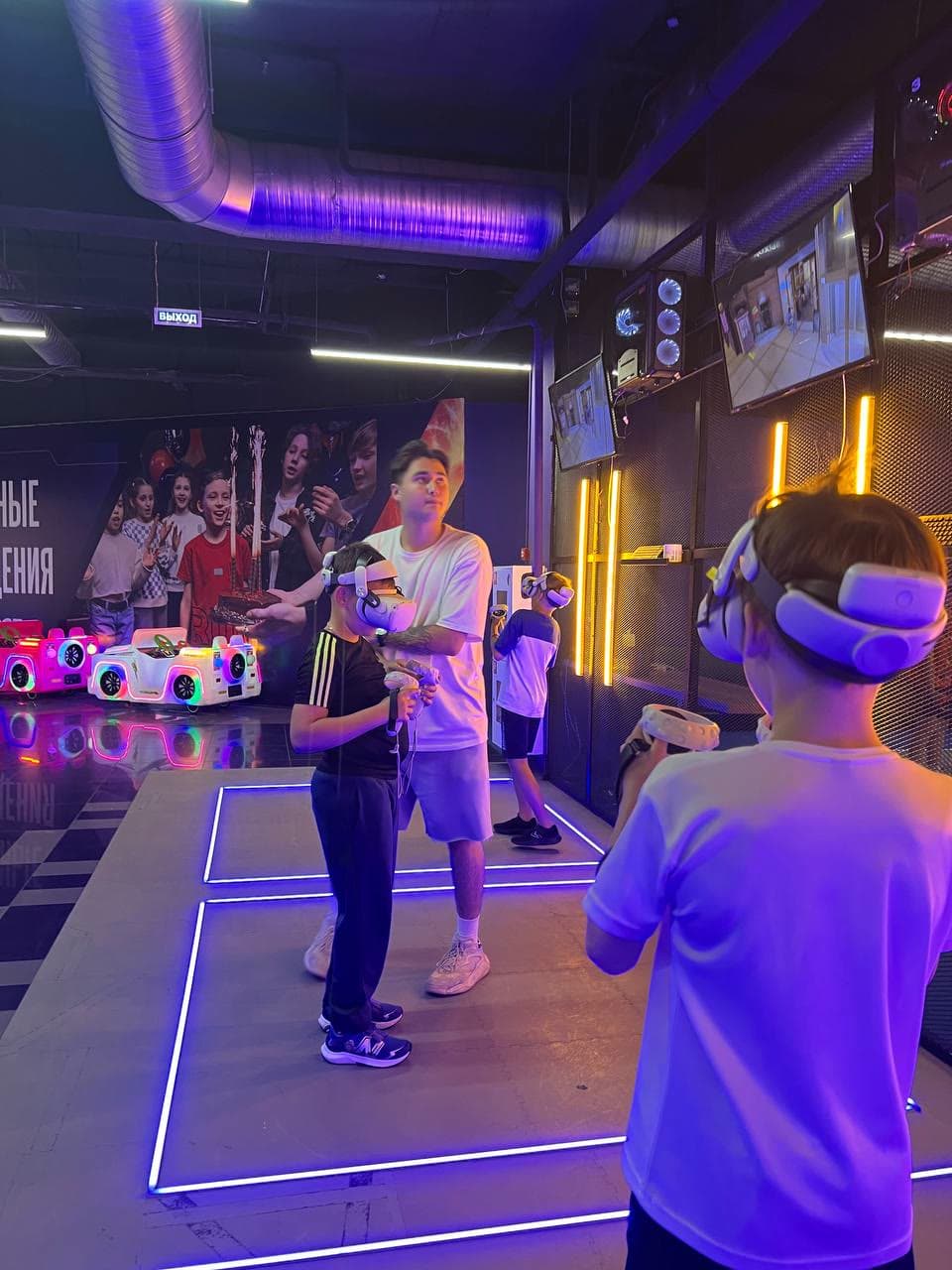
A family entertainment center business earns when one visit keeps a whole group busy for hours and brings them back for the next birthday. A free-roam VR arena fits that model: 8 to 12 or more players share one space, children from 6 have their own games, and parties and corporate groups book ahead. Metaforce VR Arena gives an FEC the games and support for a flat subscription, with no franchise fee and no revenue share.
Why add VR to a family entertainment center?
Most FECs are built around classic attractions that have been around for decades. They work, but guests who have visited three times have seen everything. A VR arena adds three things a classic floor often lacks:
- Something new to come back for. Metaforce releases new maps or games every 6 months, included in the subscription. A trampoline park can't change its layout twice a year; a VR arena can change the whole world players see.
- An attraction for teenagers and adults. Many FEC attractions target young children. Team shooters bring in teenagers, friend groups and companies, the guests who are hardest to attract to a family venue.
- A group product. One arena booking covers a whole party. That makes VR an easy add-on to your existing birthday and corporate packages.
Which FEC attractions does a VR arena complement?
A typical family fun center combines several attraction types. Here is where a free-roam VR arena sits among them:
| Attraction type | Main audience | How guests play | Content changes |
|---|---|---|---|
| Soft play, playgrounds | Toddlers and young children | Individually, with parents nearby | Rarely |
| Trampolines | Children and teenagers | Individually or in small groups | Rarely |
| Arcade machines, redemption games | All ages | Individually or in pairs | When machines are replaced |
| Bowling | Families, adults, companies | Teams on a lane | Rarely |
| Laser tag | Children, teenagers, groups | Teams in a physical maze | When the maze is rebuilt |
| Free-roam VR arena (Metaforce) | Kids from 6, teenagers, adults, companies | Teams of 8 to 12 or more on one arena | New maps or games every 6 months |
VR doesn't replace these attractions; it covers the age group and the "something new" demand they leave open. If your center already runs laser tag, see how the two compare in VR laser tag.
What games work for a family audience?
Metaforce has five released games, all developed in-house:
- Mini Games (6+): short, bright games for kids and families, such as catching runaway creatures with a net and competing in speed and accuracy.
- TeamForce, StarForce, Elevators and Portals (7+): team shooters with different mechanics, from a tactical battle with cover to teleports and portals.
- Zombies (9+): a co-op survival game, coming soon.
Each game supports 4–20 players. Because players walk physically and movement in the game matches real movement, motion sickness is less common than in joystick-based VR, though it can't be ruled out for everyone. More on each title in VR games for arcades.
How much space and power does a VR arena need inside an FEC?
| Parameter | Metaforce requirement |
|---|---|
| Play area | 50–300 m² |
| Total area, including reception and lounge | 100–700 m² |
| Optimal format | 150–250 m² total with a 100–150 m² play area |
| Power | 10–15 kW |
| Floor | Level |
| Ceiling height | From 2.5 m |
This works in practice: a partner arena running Metaforce games already operates inside a family entertainment center in Voronezh. In an existing FEC you may already have a reception, party rooms and a café. In that case the arena itself needs less extra space, because guests can wait and celebrate in rooms you already run. Send us your floor plan and we will tell you what fits; maps are rebuilt around the exact layout of your arena. See VR arena design for layouts.
How does a VR arena earn money in an FEC?
The same formats our own arenas sell plug into an FEC's existing sales:
| Format | How it fits an FEC |
|---|---|
| Hourly play | Walk-in guests and families already in the center |
| Whole-arena rental | Groups of friends, school classes, clubs |
| Birthday party packages | Add VR as a top-tier option in your existing party menu |
| Corporate events and team building | Weekday and evening demand when families are at work and school |
| Gift certificates (12 months, sold online; franchise package) | Cash in advance, often bought for holidays |
As an illustration: in our Russian arenas, 1 hour per player costs from about RUB 800 to RUB 2,300, and the whole arena costs about RUB 5,500–19,900 per hour. Metaforce arenas in Russia make RUB 500,000–1,500,000 in monthly revenue depending on the city, the venue and occupancy, with payback from about one year. Inside an FEC, part of the setup (lounge, reception, staff) can be shared, but that has to be calculated for your venue. Our VR birthday party page shows how party packages are built.
VR arena inside an FEC: how it fits your business plan
In a family entertainment center business plan, a VR arena is best treated as one more zone on an existing floor, not as a new venue. It takes a play area from 50 m² (538 sq ft); the optimal format is 150–250 m² in total (1,614–2,690 sq ft), and in an FEC much of that total is already covered by your reception, café and party rooms. The space requirements are in the table above.
Audience. Plan the arena around the gaps your floor leaves open. Mini Games (6+) give younger kids and parents a shared activity, while TeamForce, StarForce, Elevators and Portals (7+) are aimed at older kids, teenagers, adults and corporate groups. If your center leans on soft play or trampolines, the arena is where guests who have outgrown them go next. We cover both cases in VR arena for indoor playgrounds and VR arena for trampoline parks.
Placement. Put the arena next to party rooms and the café rather than in a far corner: groups move between attractions, and parents wait where they can sit. A level floor, ceilings from 2.5 m (8.2 ft) and 10–15 kW are the fixed conditions; columns and irregular walls are built into the maps.
Budget lines. Equipment, renovation and the subscription are the new costs; staff need a dedicated game master during sessions. There is no franchise fee or royalty, so the arena doesn't add a percentage on top of your FEC revenue.
Choosing a format. If you are deciding which entertainment franchise to add, or comparing a full family entertainment center franchise with a single attraction, see our entertainment franchise comparison: VR arena, trampoline park, escape room, laser tag, indoor playground, mini golf and bowling side by side, with sourced figures.
Is this a family entertainment center franchise?
Not in the classic sense. Metaforce doesn't sell a whole FEC concept with its own brand on the door. It's a subscription to games and know-how for a VR arena that you can run as part of your center:
| Term | Price (taxes included, paid upfront) |
|---|---|
| 6 months | $4,990 |
| 12 months (most popular) | $7,990 |
| 24 months | $14,990 |
| After the term | Another fixed term, or $799 per month |
There is no franchise fee, no royalty, no revenue share, no marketing fee and no penalties. You buy equipment (headsets, computers, tracking) from any supplier and pay for the venue and renovation yourself. When the subscription ends, access to the games stops. For the full cost picture, see franchise cost.
The subscription includes:
- games adapted to your venue layout;
- launch support, staff training and a personal manager;
- a knowledge base on equipment setup, cash handling, staff routines, CRM and headset care;
- with the franchise package, a website, the network CRM and a marketing kit;
- new maps or games every 6 months.
About 30 arenas in Russia, Kazakhstan, Israel and Slovakia run Metaforce games, 10 of them under the partner's own brand. That option suits FECs that want VR to carry the center's name.
What should an FEC owner check before adding VR?
- Space. Do you have a level area of at least 50 m² with ceilings from 2.5 m?
- Power. Can you supply 10–15 kW to that area?
- Staff. Who will run sessions? VR needs a dedicated game master, not a cashier doing it on the side.
- Party flow. Can your party rooms handle groups coming off the arena?
- Audience. Do you have enough teenagers and adults in your catchment, or will you need to market to them?
Apply now and send your floor plan: we'll tell you whether your center can host an arena and what it would look like.
FAQ
What are good family entertainment center ideas for teenagers and adults?
Team-based attractions where groups play together: free-roam VR arenas, laser tag, bowling and escape-style games. A VR arena with team shooters is one of the few attractions that also works for corporate events.
Can a VR arena work inside an existing FEC?
Yes. A Metaforce arena needs a play area of 50–300 m², 10–15 kW of power, a level floor and ceilings from 2.5 m. Reception and lounge can be shared with the rest of the center.
From what age can children play?
Mini Games are designed for kids and families from 6. The shooters are 7+, and Zombies, coming soon, is 9+.
Can the arena carry my FEC's brand instead of Metaforce?
Yes. 10 of the roughly 30 arenas in our network run Metaforce games under their own brand.
Do I pay a percentage of revenue?
No. You pay a subscription from $4,990 for 6 months, then $799 per month. There is no royalty, revenue share or marketing fee.