
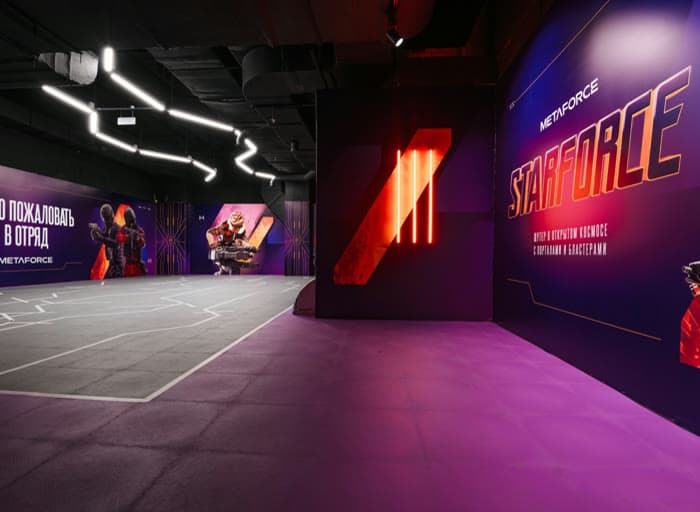
Neither free-roam VR nor VR booths earns more per square meter by default. At full load, booths can show a higher theoretical revenue per square meter because each station takes little floor space; in practice, the result depends on how many of those hours you actually sell. A free-roam arena sells the whole space to a group in one booking, often days ahead, which usually makes its occupancy higher and more predictable. The way to decide is to run both formats through the same formula with your own local inputs.
This article gives that formula, two worked examples and the factors that change the answer. For an introduction to the format itself, see our free-roam VR guide.
How do you compare two VR formats fairly?
Compare them on the metric that matches your biggest cost. For most venues that cost is rent, which is charged per square meter. So the fair metric is revenue per square meter of total venue per month, not revenue per headset or per session.
The formula:
Revenue per m² per month = (players per hour × price per player-hour × hours open per month × occupancy) ÷ total m²
Where:
- Players per hour is how many paying players the format can serve in one hour, after changeover between sessions.
- Price per player-hour is the average price converted to one player for one hour.
- Hours open per month is your schedule, for example 12 hours × 30 days = 360 hours.
- Occupancy is the share of that capacity you actually sell, between 0 and 1.
- Total m² includes everything you pay rent for: the play area, queue or lounge, reception and storage. Using only the play area flatters both formats.
Two inputs do most of the work: occupancy and total m². They are also the two that are easiest to get wrong.
What does a free-roam arena look like in this formula?
Some inputs for a Metaforce VR Arena are confirmed; others depend on your market.
| Input | Metaforce arena | Source |
|---|---|---|
| Players at once | 8 to 12 or more, depending on venue size (a game supports 4–20) | Confirmed |
| Total venue | Optimal 150–250 m², with a 100–150 m² play area | Confirmed |
| Price per player-hour | In our Russian arenas, from about RUB 800 to RUB 2,300 | Confirmed, Russia only |
| Whole-arena rental | In our Russian arenas, about RUB 5,500–19,900 per hour | Confirmed, Russia only |
| Occupancy | Depends on your sales | Your estimate |
Worked example A, free-roam arena (illustrative inputs):
- 10 players at once, sessions sold by the hour → 10 players per hour
- RUB 1,500 per player-hour (an illustrative value inside the Russian range)
- 360 hours open per month
- 200 m² total venue
- Occupancy: tested at 10% and 25% (hypothetical)
| Occupancy (hypothetical) | Monthly revenue | Revenue per m² per month |
|---|---|---|
| 10% | RUB 540,000 | RUB 2,700 |
| 25% | RUB 1,350,000 | RUB 6,750 |
Note what this says. With these illustrative inputs, the network's published revenue range for Russia, RUB 500,000–1,500,000 per month, corresponds to roughly 9–28% of theoretical capacity. That is realistic for the format: most revenue arrives on evenings, weekends and holidays, while weekday mornings stay quiet, and one booked hour fills the whole arena with a group. Treat the occupancy line as the number to argue about in your own plan.
What does a booth zone look like in the formula?
We don't operate booths, so every input below is hypothetical, chosen only to show the arithmetic. Replace them with real quotes and prices from your market.
Worked example B, booth zone (all inputs hypothetical):
- 6 booths
- Each session 10 minutes of play plus 5 minutes of changeover → 4 sessions per booth per hour
- Price per 10-minute session: RUB 400 → equivalent to RUB 2,400 per player-hour of play, or RUB 1,600 per booth-hour once changeover is included
- Total footprint: 6 booths × 6 m² + 24 m² for queue, counter and storage = 60 m²
- 360 hours open per month
Players served per hour = 6 booths × 4 sessions = 24.
| Occupancy (hypothetical) | Monthly revenue | Revenue per m² per month |
|---|---|---|
| 10% | RUB 345,600 | RUB 5,760 |
| 25% | RUB 864,000 | RUB 14,400 |
At the same occupancy, the hypothetical booth zone shows a higher revenue per square meter. That is the honest arithmetic: a booth packs paying players densely into a small footprint.
So why do operators choose free roam?
Because occupancy is not the same for both formats, and per-m² revenue is not the only number that matters.
Occupancy behaves differently. Booths sell short sessions to walk-in traffic. Their occupancy follows footfall past the unit, minute by minute. A free-roam arena sells planned group outings: birthday parties, whole-arena rentals, corporate events, gift certificates. Those are booked ahead and fill the arena in one sale. In these two examples, the booth zone needs a bit less than half the arena's occupancy to match it per square meter. A booth zone at 10% (RUB 5,760 per m²) earns less than an arena at 25% (RUB 6,750 per m²), even though the booth zone wins at equal occupancy.
Absolute revenue matters, not only the ratio. A 60 m² booth zone has a ceiling on how much it can make in total. A free-roam arena of 150–250 m² sells group packages with a much larger check per booking.
Labor scales differently. A booth zone serves many small transactions, each needing check-in, fitting and changeover. An arena serves fewer, larger groups. Depending on local wages, this can shift profit per square meter more than revenue does.
What guests come for. Booths offer a short individual experience. Free roam offers a shared one: players walk through the same virtual world, see each other and play as a team. Movement in the game matches movement in the room, so motion sickness is less common than with joystick movement, though not impossible. That shared experience is what parents and companies book for events, and what brings groups back when new content appears. Metaforce adds new maps or games every 6 months.
Rent position. Booths depend on high-footfall, high-rent positions. An arena that sells by booking can work in a less visible unit with lower rent, which improves the per-m² result from the cost side.
How do you decide for your venue?
Run both formats through the formula, then check these questions:
- Where does your demand come from? Mostly passers-by in a busy corridor favors booths. Planned groups, families and companies favor free roam.
- What is your rent per m²? Very high rent pushes toward dense formats. Moderate rent makes a larger arena with group sales viable.
- What occupancy can you prove? Booth occupancy depends on footfall data from the landlord. Arena occupancy depends on your sales plan for parties and events. Ask which one you can support with evidence.
- What is the break-even occupancy? Rearrange the formula: break-even occupancy = monthly fixed costs ÷ (players per hour × price × hours open). The format with the lower break-even occupancy for your venue carries less risk.
- Can you combine them? Some venues use a small number of stations as a showcase near the entrance and the arena as the main product. If you do, measure each separately.
For layout and capacity planning, see the VR arena design guide. For the overall budget, see the VR franchise cost page.
What does Metaforce offer for the free-roam format?
Metaforce VR Arena is a free-roam format only. Partners receive five released multiplayer games developed in-house, maps rebuilt around the exact venue layout, launch support, staff training, a manager, a knowledge base and new content every 6 months. With the franchise package, partners also get a website, the network CRM and a marketing kit. The subscription, taxes included, costs $4,990 for 6 months, $7,990 for 12 months or $14,990 for 24 months, then $799 per month, with no franchise fee and no revenue share. Equipment can be bought from any supplier.
The network today has about 30 arenas in Russia, Kazakhstan, Israel and Slovakia.
Related articles
- Are VR Arcades Profitable? What the Metaforce VR Arena Network Shows
- How to Choose a Location for a VR Arena: Mall, FEC or Standalone Venue
- VR Laser Tag vs Classic Laser Tag: Keep, Convert or Add VR to Your FEC?
FAQ
Which earns more per square meter, free-roam VR or VR booths?
At equal occupancy, booths can show more revenue per square meter because they are denser. Free-roam arenas usually achieve higher and more predictable occupancy through group bookings. Compare both with your local inputs.
What formula should I use to compare VR formats?
Revenue per m² per month = players per hour × price per player-hour × hours open per month × occupancy ÷ total m², counting all rented space.
How many players does a free-roam arena serve at once?
On a Metaforce arena, 8 to 12 or more people play at once depending on the venue size; a game supports 4 to 20 players.
Why include the lounge and reception in total m²?
Because you pay rent for them. Counting only the play area makes any format look better than it is.
Are the booth figures in this article real?
No. They are hypothetical inputs to show the arithmetic. Metaforce operates only the free-roam format.
Does Metaforce sell booth content?
No. Metaforce games are made for free-roam multiplayer arenas.
Apply now and we'll help you test the numbers for your space.