
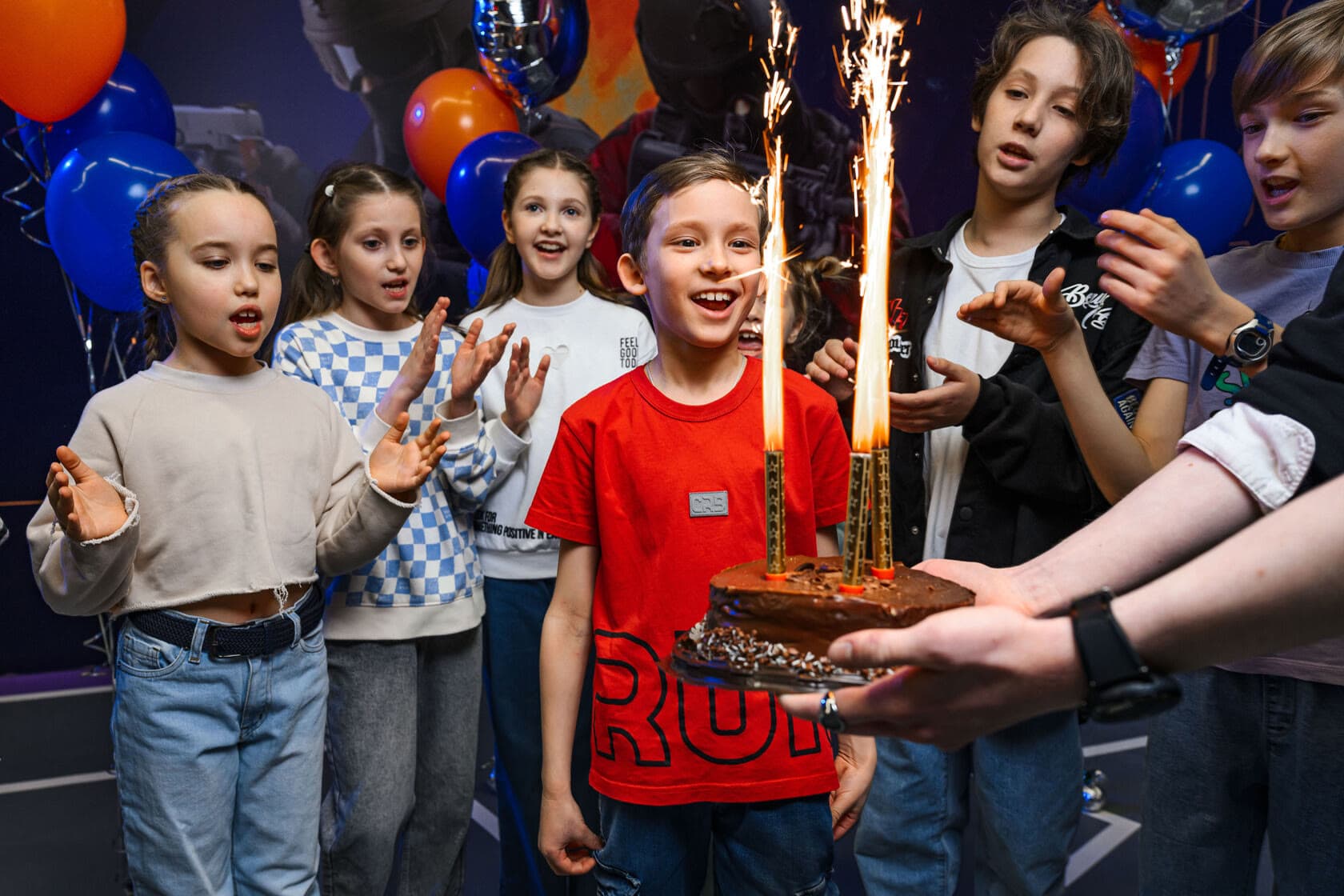
A VR birthday party is a package that sells the whole arena to one group: a set amount of game time, a private lounge for the celebration and a host who runs the games. For a venue owner it is one of the most predictable revenue lines, because parties are booked ahead, paid as a fixed package and fill weekend slots that walk-ins can't. This page shows how Metaforce VR Arena venues build, staff and schedule their party business.
Why do birthday parties matter for a VR arena?
Parents search for a "vr birthday party" or a "kids vr party" because they want something new for a child who has already had a trampoline party and a bowling party. For the arena, a birthday booking has three advantages over hourly play:
- One sale fills the arena. A Metaforce game supports 4–20 players, and on one arena 8 to 12 or more play at once. A party brings exactly that group.
- It is booked in advance. You know your weekend load days or weeks ahead and can staff for it.
- Every party markets the next one. Each child at the party is a potential next birthday booking, and the parents see the venue too.
Birthday parties are one of the five formats arenas in our network sell, alongside hourly play, whole-arena rental, corporate events and gift certificates.
What goes into a party package?
In our Russian arenas, every party package has the same core, and tiers differ by time, group size and extras:
- private arena game with a choice of 5 games: TeamForce, StarForce, Elevators, Portals and Mini Games;
- a separate lounge zone for the celebration;
- a staff member assigned to the group for the whole event;
- a greeting for the birthday child;
- a console game in the lounge, plus free tea and coffee;
- briefing and equipment time included in the package;
- the client may bring their own cake, food and drinks.
The last point keeps operations simple: the arena doesn't need a kitchen, and the package price stays focused on what the arena actually sells, game time.
How are party packages tiered?
Example from Metaforce arenas in Russia (Yekaterinburg, October 2026):
| Package | Arena time | Total event | Group size | Extras | Weekday | Weekend |
|---|---|---|---|---|---|---|
| S | 1 h | 1 h 45 min | up to 10 | — | RUB 12,900 | RUB 14,900 |
| M | 2 h | 2 h 45 min | up to 16 | — | RUB 19,900 | RUB 23,900 |
| L | 2 h | 2 h 45 min | up to 20 | 2 h on VR zones | RUB 25,900 | RUB 29,900 |
| XL | 3 h | 3 h 45 min | up to 20 | 3 h on VR zones | RUB 32,900 | RUB 43,900 |
Each package adds 45 minutes in the lounge on top of the arena time. "VR zones" are separate small VR stations that some of our venues run next to the arena. Prices differ by city: our Moscow arenas run the same S–XL ladder at higher prices and with up to 25 people in the largest package. Your prices will depend on your market; the structure is what transfers.
What is the pricing logic behind the tiers?
- Sell by the group, not by the head. Clients compare packages, not per-player rates. A fixed price for "up to 10 people" is easier to accept than a per-child calculation.
- Group size above arena capacity. The group limit (16–20) is higher than the number who play at once (8–12). The group rotates between the arena and the lounge, so the event feels busy and the arena is never idle.
- Weekend premium. Saturday and Sunday slots sell out first, so they carry a higher price. Charge holidays at the weekend rate.
- Upsell through time and extras, not food. The difference between tiers is more game time and extra attractions, which cost the arena little once it is built.
- Clear rules for overtime. In our Moscow arena, extra lounge time is sold by the hour when available.
How do you schedule party slots?
A typical 2-hour package, as your staff run it:
| Time | What happens |
|---|---|
| 0:00 | Group arrives, the host meets the birthday child and the parents |
| 0:05 | Briefing and headsets on, first half of the group enters the arena |
| 0:15 | Round 1: Mini Games for younger children, a shooter for 7+ |
| 0:45–1:00 | Groups swap; the others wait in the lounge with the console game |
| 1:00–2:00 | More rounds, teams change, the birthday child leads a squad |
| 2:00–2:45 | Cake and celebration in the lounge |
In our Russian arenas, about 15 minutes of each booked hour go to instruction and equipment, and about 45 minutes to play. Build your calendar around that, and leave a buffer between parties for headset cleaning and resetting the lounge. Because the lounge phase runs after the arena time, the next group can start in the arena while the previous party is still celebrating, provided the venue has a second lounge or a large enough one.
How do you staff a party?
- One host per party stays with the group from arrival to goodbye: greeting, briefing, the birthday moment, photos.
- A game master in the arena starts rounds, fits headsets and watches the players. On a busy weekend this is a separate person from the host.
- Someone at reception handles check-in, payments and the next group's arrival.
Players walk physically and their in-game movement matches real movement, so motion sickness is less common than in joystick-based VR. It can't be ruled out for everyone, so train staff to spot it and pause a child who feels unwell. Staff training and a knowledge base on staff routines come with the Metaforce subscription.
Which games should you put into a kids' party?
| Age group | Games |
|---|---|
| 6–7 | Mini Games: short, bright games such as catching runaway creatures with a net |
| 7–10 | Portals and StarForce: fast arcade action, teleports and portals |
| 10+ and teenagers | TeamForce and Elevators: tactical team battles |
| Teens and adults, co-op | Zombies (9+), coming soon |
Mixing a family game and a shooter in one party lets you serve younger siblings and older children in the same booking. Our arenas also sell adult birthday packages built around the shooters. More on each title in VR games for arcades.
What does the arena need to sell parties well?
- A lounge. The total venue (100–700 m², optimal 150–250 m²) includes reception and a lounge where groups wait and celebrate. Without it, you can't sell parties. See VR arena design.
- Online booking and a CRM. With the franchise package, partners get a website and the network CRM, so the party calendar and each client's history sit in one place.
- Marketing materials. A marketing kit comes with the franchise package; local promotion is run by your team.
How do you start a party business with Metaforce VR Arena?
You subscribe to the games and support instead of paying royalties: $4,990 for 6 months, $7,990 for 12 months or $14,990 for 24 months, then $799 per month, taxes included. No franchise fee, no revenue share, no marketing fee. Venue, renovation and equipment are paid separately. In Russia, Metaforce arenas start from RUB 2.5 million of investment and make RUB 500,000–1,500,000 a month depending on the city, the venue and occupancy. See franchise cost, corporate events in VR team building and the full VR arcade business overview.
FAQ
How much should my arena charge for a VR birthday party?
It depends on your market. The table above is an example from our Yekaterinburg arenas; use the structure (tiers by time and group size, weekend premium) and set prices from local competitors and rent.
What age range can a VR party package cover?
Mini Games are designed for children from 6. The shooters are 7+, and Zombies, coming soon, is 9+.
How large a party can one arena handle?
On one arena 8 to 12 or more play at once, depending on venue size. Packages in our arenas allow 10 to 20 people (up to 25 in one Moscow venue), who rotate between the arena and the lounge.
Does the arena need to provide food?
Not necessarily. In our arenas, clients bring their own cake, food and drinks, and the arena provides the lounge, tea and coffee.
Can I sell adult VR parties too?
Yes. Our arenas sell adult birthday packages, and the team shooters suit adult groups and corporate events.