
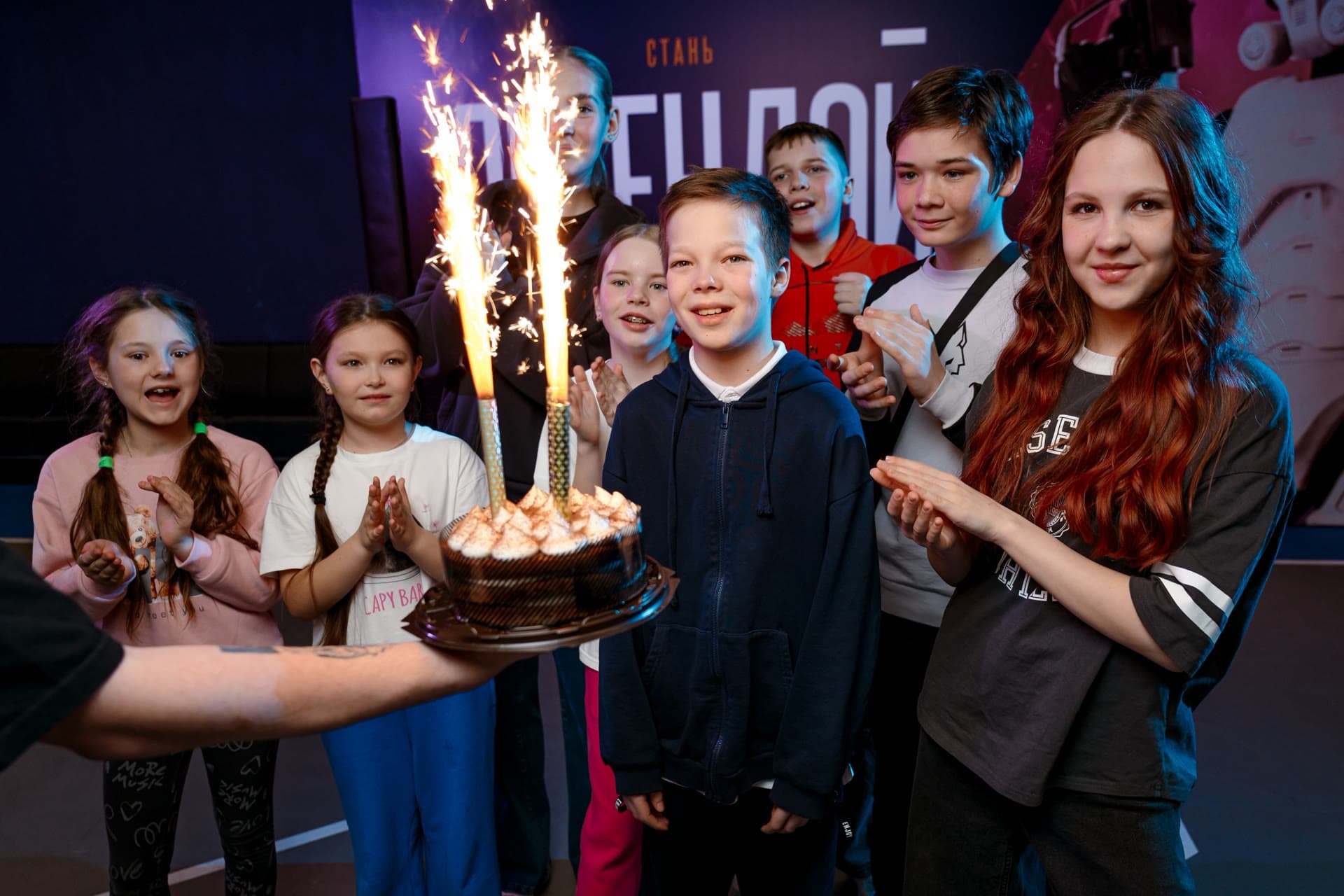
An indoor playground business is built for young children: soft play frames, slides, ball pits and a café where parents wait. The challenge comes a few years later, when those children grow too big for the frame and the family stops coming. A free-roam VR arena gives the same families a reason to stay: kids from 6 play Mini Games, kids from 7, teenagers and parents play team games together, and the arena runs in one room of 50–300 m² (538–3,229 sq ft). Metaforce VR Arena supplies the games and support for a flat subscription, with no franchise fee and no royalty.
Why add VR to an indoor playground?
The logic is about the life cycle of a customer, not about a market statistic. A family that has been coming since the toddler years knows your venue, trusts your staff and books parties with you. When the oldest child decides soft play is "for babies", you risk losing the whole family, including younger siblings' parties.
A VR arena covers the next stage:
- Kids aged 7–14 who have outgrown soft play. Team games give them something that feels grown-up, played in a space you already run.
- Parents who play, not just wait. Mini Games and the team games are played by adults and children on equal terms, so a parent can join instead of sitting in the café.
- Older siblings at younger siblings' parties. A mixed-age birthday no longer leaves the 10-year-old bored.
- Something new twice a year. Metaforce releases new maps or games every 6 months, included in the subscription. A soft play frame can't change that often.
Which games suit a family venue?
| Game | Age | What it is |
|---|---|---|
| Mini Games | 6+ | 3 short, non-violent family games: catching runaway creatures with a net, competing in speed and accuracy |
| TeamForce | 7+ | Tactical team battle with cover |
| StarForce | 7+ | Space setting with teleports between platforms |
| Elevators | 7+ | Multi-level fight that moves between floors |
| Portals | 7+ | Arcade action with portals and surprise flanks |
| Zombies | 9+ | Co-op survival, coming soon |
For a playground, Mini Games is the natural starting point: no shooting, simple rules and rounds short enough for a six-year-old. The team games are where the 7–14 group and their parents spend their time. Each game supports 4 to 20 players. Players walk for real, and movement in the game matches real movement, so motion sickness is less common than in joystick-based VR, though it can't be ruled out for everyone. More in Mini Games.
How much space does it need?
Indoor playground franchisors describe sites of several thousand square feet:
| Brand | Typical size (as published) | Source |
|---|---|---|
| Kids Empire | 15,000+ sq ft | Franzy, 2022 FDD summary (third party) [1] |
| Kanga's Indoor Playcenter | 8,000–12,000 sq ft | Franzy, general site guidance, 2021 FDD summary (third party) [2] |
A Metaforce arena needs:
| Parameter | Metaforce requirement |
|---|---|
| Play area | 50–300 m² (538–3,229 sq ft) |
| Total venue, including reception and lounge | 100–700 m² (1,076–7,535 sq ft); a separate lounge is not required, the playground's own café and reception can serve |
| Optimal format | 150–250 m² total (1,614–2,690 sq ft) with a 100–150 m² play area (1,076–1,614 sq ft) |
| Ceiling height | From 2.5 m (8.2 ft) |
| Floor | Level |
| Power | 10–15 kW |
A playground is smaller than a trampoline park, so the space question is real. Common options:
- Convert an underused zone. A rarely booked party room or an older play area can become the play area.
- Take an adjacent unit. In a mall or retail park, a neighboring unit keeps the arena next to your reception.
- Share what you already have. Reception, the café and party rooms serve both attractions, so the arena itself needs little more than the play area.
Columns or an irregular room don't rule a space out: Metaforce rebuilds its maps around the exact layout of each venue. See VR arena design.
Indoor playground franchise or a VR add-on?
If you are still choosing a format, here is what published indoor playground franchise terms look like:
| Brand | Initial investment | Franchise fee | Royalty | Source |
|---|---|---|---|---|
| Kids Empire | $803,750–$1,765,000 | $50,000 | 8% + 2% brand fund | 2022 FDD summary [1] |
| Kanga's Indoor Playcenter | $508,500–$810,500 | $49,000 | 5% + 2% brand fund | 2021 FDD summary [2] |
These summaries are based on older FDD years; check the current FDD before any decision.
Metaforce is not a soft play franchise and doesn't sell a whole playground concept. It is a subscription to VR games and know-how for an arena you run as part of your venue, or on its own:
| Term | Price (taxes included, paid upfront) |
|---|---|
| 6 months | $4,990 |
| 12 months (most popular) | $7,990 |
| 24 months | $14,990 |
| After the term | Another term or $799/month |
There is no franchise fee, no royalty, no revenue share and no marketing fee. You buy the equipment (Meta Quest 2, 3 or 3S, or PICO 4 or PICO 4 Ultra headsets, plus computers and tracking) from any supplier and pay for the venue and renovation. When the subscription ends, access to the games stops; the equipment stays yours. Full terms are on franchise cost and no-royalty franchise. To compare VR with trampoline parks, escape rooms, laser tag and other formats, see our entertainment franchise comparison.
How does a VR arena earn inside a playground?
It plugs into what you already sell:
| Format | How it fits a playground |
|---|---|
| Hourly play | Families already in the venue, older siblings |
| Birthday packages | VR as an upgrade tier for kids 7+ and mixed-age parties |
| Whole-arena rental | School classes, clubs, friend groups |
| Family sessions | Parents and kids on Mini Games together |
| Corporate events | Weekday evenings, when the playground is quiet |
| Gift certificates (12 months, sold online; franchise package) | Holiday gifts, paid in advance |
We publish economics only for Russia, in rubles; they are not a forecast for a US venue. In Russia, 1 hour per player costs from about RUB 800 to RUB 2,300, and the whole arena costs about RUB 5,500–19,900 per hour. Metaforce arenas in Russia make RUB 500,000–1,500,000 in monthly revenue depending on the city, the venue and occupancy, with payback from about one year. See also VR birthday party.
What to check before adding VR
- Room. A level area with a play zone from 50 m² and ceilings from 2.5 m.
- Power. 10–15 kW to that area.
- Staff. VR needs a dedicated game master during sessions. Metaforce trains staff and provides a knowledge base, including headset care.
- Party flow. Can your party rooms take groups coming off the arena?
- Timing. Launch takes from a week to several months after signing, depending mainly on the venue and renovation.
Metaforce games run in about 30 arenas in 4 countries, including 2 of our own in Yekaterinburg, and a partner arena operates inside a family entertainment center in Voronezh. For venues with a wider mix of attractions, see family entertainment center and VR arena for trampoline parks.
Apply now and send us your floor plan.
FAQ
From what age can children play?
Mini Games are rated 6+. TeamForce, StarForce, Elevators and Portals are rated 7+.
Is Metaforce a soft play franchise?
No. It is a subscription to free-roam VR games and know-how for an arena you run inside your playground or separately. There is no franchise fee and no royalty.
Can parents play with their kids?
Yes. All games are played by children and adults together, and Mini Games are designed for families.
How much space do I need?
A play area from 50 m² (538 sq ft), ceilings from 2.5 m (8.2 ft), a level floor and 10–15 kW. Reception, café and party rooms can be shared with the playground.
What does it cost?
The subscription is $4,990 for 6 months, $7,990 for 12 months or $14,990 for 24 months, taxes included, then another term or $799 per month. Equipment, venue and renovation are paid separately.
Sources
Checked October 2026. Figures are as published by each source and based on the FDD year shown; they may have changed. Always confirm current terms with each franchisor.
- Franzy, Kids Empire, 2022 FDD summary (third party): https://franzy.com/franchises/kids-empire
- Franzy, Kanga's Indoor Playcenter, 2021 FDD summary (third party): https://franzy.com/franchises/kangas-indoor-playcenter