
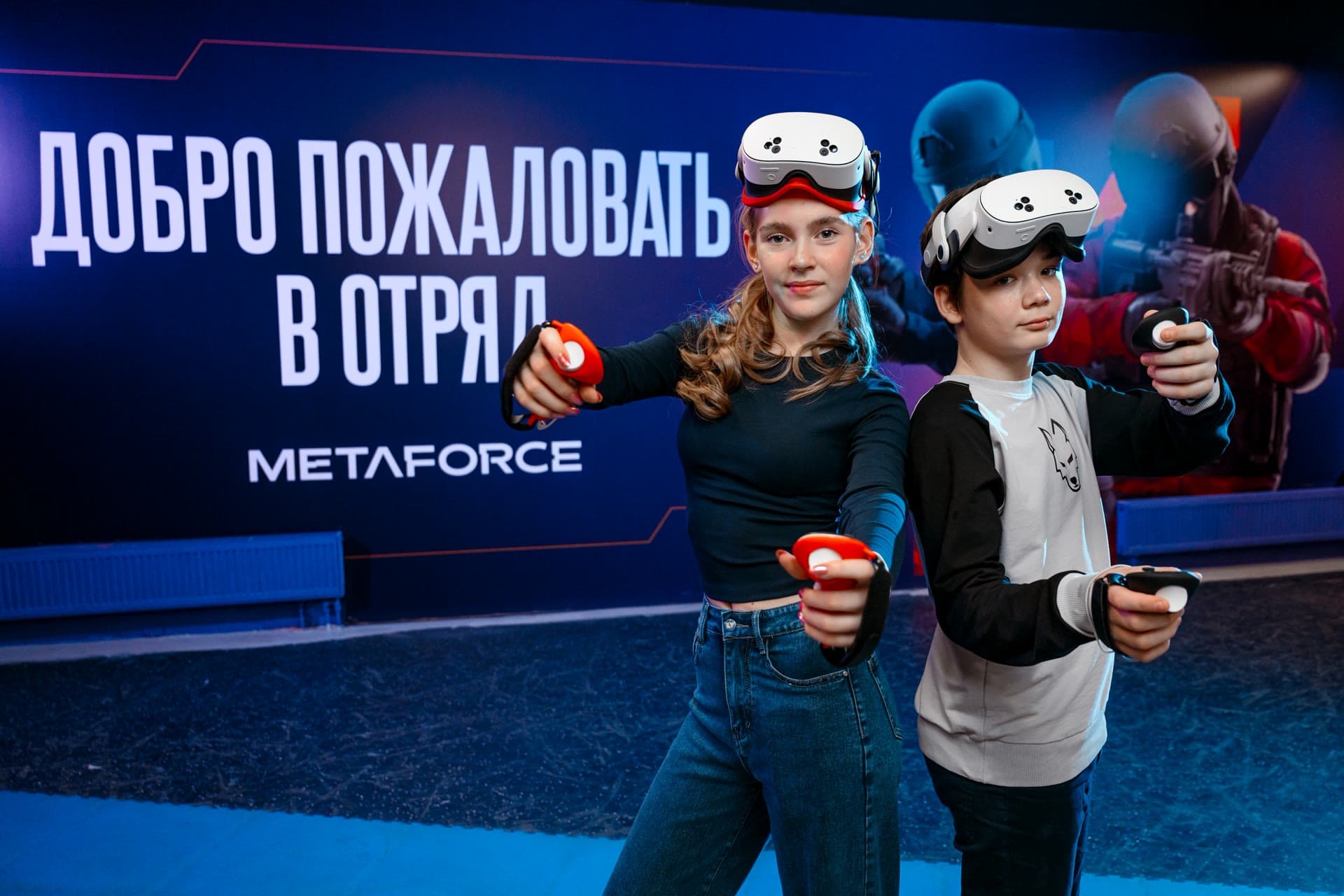
Yes, a VR arena can work in a city of 20,000–100,000 people, but it is a different business from an arena in a city of a million. Metaforce VR Arena games run in cities from 20,000 residents, including Karpinsk in Russia's Urals and Aksay near Rostov-on-Don. In a small city the arena serves the whole local market rather than one neighborhood, so venue size, fixed costs and repeat visits matter more than location in a busy mall.
We don't have a published case study with revenue figures for a small-city arena, so this article doesn't invent one. It explains how the small-city model differs, where the network already works in smaller places and what to check before you commit.
Why does city size matter for a VR arena?
A free-roam VR arena sells time in one shared space to groups: birthday parties, friend groups, families, corporate events. Demand comes from people who plan a visit, not from passers-by. That has two consequences for small cities:
- The catchment is the whole city. In a large city, an arena competes for a few districts around it. In a town of 30,000, people will cross town for a birthday party, because there are only a few options.
- The same people come back. A big city supplies a stream of first-time guests. A small city has a limited pool, so the business depends on repeat visits: the same families, the same schools, the same companies, year after year.
Neither point is good or bad in itself. They just change what you optimize.
Where does Metaforce already work in smaller cities?
The network has about 30 arenas in Russia, Kazakhstan, Israel and Slovakia, in cities of very different sizes. Three examples outside the largest cities:
| City | Approximate population | Arena | Context |
|---|---|---|---|
| Karpinsk, Sverdlovsk region, Russia | About 25,000 (2025 estimate) | Partner arena under its own brand | A small industrial town in the northern Urals |
| Aksay, Rostov region, Russia | About 48,000 (2021 census) | Metaforce arena in the MEGA Aksay mall | A town on the edge of Rostov-on-Don; the mall serves the wider metro area |
| Kokshetau, Kazakhstan | About 177,000 (2024 estimate) | Metaforce arena | A regional center, larger than the range in this article but far from a capital-size market |
Population figures are from public sources listed at the end. Note the difference between Karpinsk and Aksay: an arena in a small standalone town and one in a small town next to a large city face very different markets. Before using either as a reference for your own plan, define which of the two situations you are in.
What changes in a small-city business model?
| Factor | Large city | City of 20,000–100,000 |
|---|---|---|
| Rent | Usually higher | Usually lower, more choice of premises |
| Competition | Several VR and entertainment venues | Often few or none in the same format |
| Audience pool | Large, many first-time guests | Limited, success depends on repeat visits |
| Marketing | Paid ads, maps, high competition for attention | Word of mouth, schools, local social media groups, local companies |
| Staff | Larger hiring pool | Smaller pool, so training and retention matter |
| Corporate demand | Many offices | Fewer offices, but local employers and public institutions |
| Pricing | Set by competition | Set by local incomes |
The biggest structural difference is fixed costs. In a smaller market, revenue has a lower ceiling, so every fixed monthly cost weighs more. That makes three decisions critical: venue size, the content model and the fee structure.
How large should a small-city arena be?
Smaller than you might think. A Metaforce arena works with a play area from 50 m² and a total venue from 100 m²; the optimal format is 150–250 m² in total with a 100–150 m² play area. On one arena 8 to 12 or more people play at once, depending on the venue size, and a game supports 4–20 players.
In a small city, the question is not "how many people can I fit at peak?" but "how many hours a week can I fill?". A compact arena with a good lounge for parties often makes more sense than a large hall that stands half-empty on weekdays. The other requirements stay the same: 10–15 kW of power, a level floor and ceilings from 2.5 m. Maps are rebuilt around the exact layout of each venue, which helps in small towns where purpose-built premises are rare. Layout guidance is in VR arena design.
Why is new content more important in a small city?
Because the audience is the same people. A family that has played every map three times stops coming, and in a town of 30,000 there is no stream of new families to replace them quickly.
This is where the content model matters. Metaforce releases new maps or games every 6 months, included in the subscription. Today there are 5 released games: TeamForce (10 maps), StarForce (4 maps), Elevators (2 maps), Portals (3 maps) and Mini Games for children from 6 (3 games). Zombies, a co-op survival game for 4–10 players, is coming soon. Each release gives the arena a reason to contact its past guests again.
Which revenue formats matter most in a small city?
The same five formats as anywhere, but with different weight:
- Birthday parties. In a small city, an arena can become a standard option for children's parties. Each party introduces a dozen families to the venue. See how arenas build this line on VR birthday party.
- Corporate events. Fewer offices, but local employers, banks, retail chains and public institutions still hold year-end events.
- Whole-arena rental. Friend groups, school classes, sports teams.
- Hourly play. Weekends and school holidays.
- Gift certificates. Useful before holidays; with the franchise package they are valid for 12 months and sold online.
As a reference for scale only: in Russia, Metaforce arenas start from RUB 2.5 million of investment and make RUB 500,000–1,500,000 a month depending on the city, the venue and occupancy, with payback from about one year. Smaller cities are not automatically at the bottom of that range, and large cities not automatically at the top; occupancy and management decide more. We don't publish figures for individual arenas.
Why does the fee model matter more in a small city?
A royalty takes a percentage of revenue every month. A subscription is a fixed amount. In a small city, both have a point to consider:
- A fixed fee is predictable, and you keep all the upside on strong months, like December or school holidays. But it is the same in a slow month, so plan cash for the quiet season.
- A royalty falls in weak months, but you pay it on every strong month for the life of the contract.
Metaforce uses a subscription: $4,990 for 6 months, $7,990 for 12 months or $14,990 for 24 months, then $799 per month (taxes included), with no franchise fee, no royalty, no revenue share and no marketing fee. Equipment can be bought from any supplier, and the venue, renovation and equipment are paid separately. When the subscription ends, access to the games stops. The comparison is worked through on no-royalty franchise, and the full budget on franchise cost.
What should you check before opening in a small city?
- Is your town standalone or part of a metro area? Aksay and Karpinsk are both small, but only one sits next to a city of a million.
- What do families do for birthdays now? Count the party venues and what they charge. That is your real competition and your price reference.
- Who are the local employers? List the companies and institutions with teams of 10 or more.
- Is there a suitable venue? A level floor, ceilings from 2.5 m, 10–15 kW and at least 100 m² in total. A small mall, a former store or an existing FEC can work.
- Who will run it? In a small town, one reliable manager decides the outcome. Plan training: Metaforce provides launch support, staff training, a manager and a knowledge base on equipment, cash handling, staff routines, the CRM and headset care.
- How will you reach repeat guests? A CRM with past clients' contacts and birthdays, and local social media groups. With the franchise package, partners get the network CRM, a website and a marketing kit.
If you are weighing a small city, send us the town, the population and the premises you have in mind. We will tell you honestly whether the format fits.
Related articles
- How to Choose a Location for a VR Arena: Mall, FEC or Standalone Venue
- Are VR Arcades Profitable? What the Metaforce VR Arena Network Shows
- How Much Does It Cost to Open a VR Arcade in 2026? A Line-by-Line Budget
FAQ
What is the smallest city where a Metaforce arena can work?
The network works in cities from 20,000 residents. One partner arena operates in Karpinsk, a town of about 25,000 in Russia's Urals.
Is there a case study with revenue for a small-city arena?
We don't publish figures for individual arenas. Network-level figures for Russia are RUB 500,000–1,500,000 in monthly revenue, depending on the city, the venue and occupancy.
Should a small-city arena be smaller?
Often, yes. The play area can start from 50 m² and the total venue from 100 m². Filling hours on weekdays matters more than peak capacity.
How do you keep guests coming back in a small town?
New content and direct contact. Metaforce adds new maps or games every 6 months, and the CRM lets you invite past guests back when new maps arrive.
Can a small-city arena run under its own brand?
Yes. 10 of the roughly 30 arenas in the network, including the one in Karpinsk, run Metaforce games under their own brand.
Sources
Population figures, checked October 2026:
- Karpinsk: Wikipedia, Karpinsk (2025 estimate; 29,113 at the 2010 census)
- Aksay: Wikipedia, Aksay, Rostov Oblast (2021 census)
- Kokshetau: Wikipedia, Kokshetau (2024 estimate, city proper)