
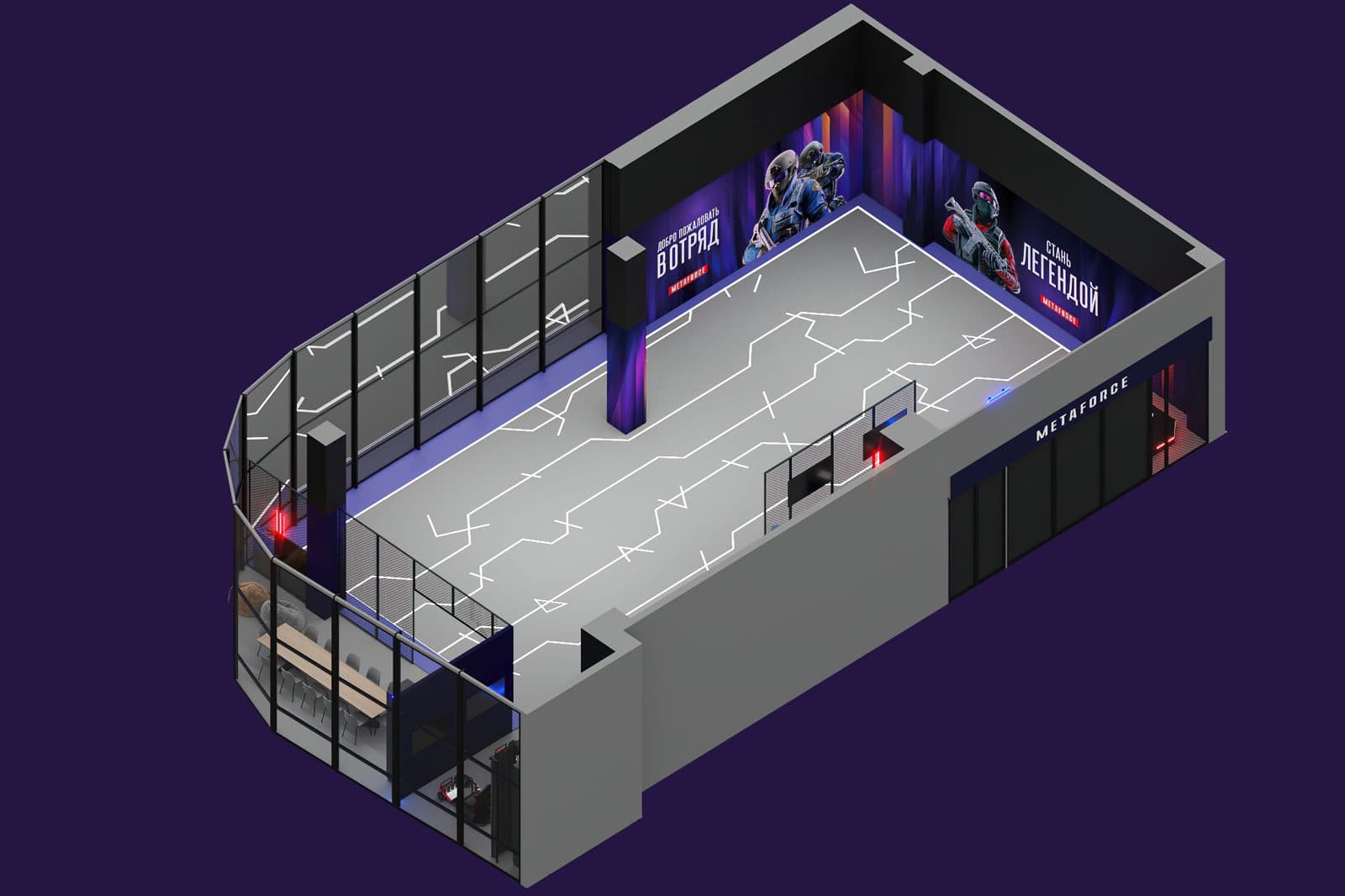
How much it costs to open a VR arcade in 2026 depends on five items: the venue, the renovation, the equipment, the content and the cash you need to survive the first months. For a free-roam Metaforce VR Arena in Russia, total investment starts from RUB 2.5 million, and the content part is a flat subscription from $4,990 for 6 months, taxes included. This article goes through each line of the budget and explains what makes it bigger or smaller.
If you only need the price list, it is on the VR franchise cost page. Here we go one level deeper: how to build your own estimate.
Why is there no single answer to "how much does a VR arcade cost"?
Because two arcades that look alike can have very different budgets. Three decisions set most of the number before you spend anything:
- Format. A free-roam arena (teams walking through a shared virtual world) needs an open hall. VR booths need a few square meters per station. This article covers free roam.
- Size. The play area decides how many people play at once, and that decides how much equipment you buy and how much rent you pay.
- City. Rent, contractor rates, wages and consumer prices all move together with the local market.
So instead of quoting one figure, we will build the budget line by line.
What are the line items in a VR arcade budget?
| Line item | Paid when | Main cost driver |
|---|---|---|
| Venue: rent, deposit, fit-out period | Before opening, then monthly | City, location inside the building, square meters |
| Renovation | Before opening | Condition of the premises, floor, electrical work |
| Equipment | Before opening | Number of players you want in one round |
| Network, IT and payments | Before opening | Number of stations, local providers |
| Reception, lounge, signage | Before opening | Size of the lounge, design level |
| Content and support (Metaforce subscription) | At signing, then by term | Term you choose: 6, 12 or 24 months |
| Hiring and training | Before opening | Local wages, team size |
| Launch marketing | Around opening | Local market, channels |
| Working capital | First months after opening | Rent, wages and how fast bookings grow |
Let's look at what drives each one.
Venue
Rent is usually the largest monthly cost, and the deposit is one of the largest one-off ones. For a Metaforce arena the venue needs a play area of 50–300 m² inside a total of 100–700 m². The optimal format is 150–250 m² in total with a 100–150 m² play area.
What moves the number:
- Square meters. Every extra meter of play area raises capacity, but you pay for it every month whether it is full or not.
- Location inside the building. A unit next to the cinema or food court costs more than one on a quiet corridor. A less visible unit can work if your sales rely on booked parties and events, not walk-ins.
- Fit-out period. Renovation and setup take weeks with no revenue. A rent-free or reduced-rent period during fit-out is a normal point of negotiation and can save a noticeable share of the launch budget.
Renovation
The arena has a short list of hard requirements: a level floor, ceilings from 2.5 m and 10–15 kW of power. Renovation cost depends on how far the premises are from that list.
- Floor. Players run with headsets on. If the floor has slopes, thresholds or damage, leveling comes first and can be one of the larger renovation items.
- Power. If 10–15 kW is not already allocated to the unit, upgrading the supply can take time and money. Check it on paper before signing.
- Ventilation. A full arena of active players gets warm. If the existing system can't cope, budget for it.
- Zoning. Reception, lounge, equipment and charging zone, staff area. The bigger the lounge, the more furniture and finishing.
Because Metaforce rebuilds its game maps around the exact layout of your venue, you don't need to demolish walls or remove columns to fit a standard footprint. That is often where renovation budgets quietly grow in other formats. Layout details are in our VR arena design guide.
Equipment
Equipment is headsets, controllers, computers and tracking. The partner buys it from any supplier, so you can compare offers rather than pay a fixed package price.
The main driver is simple: how many players you want in one round. A Metaforce game supports 4 to 20 players, and on one arena 8 to 12 or more people play at once depending on the venue size. Each player slot needs its own kit, so the equipment budget scales almost linearly with that number.
Smaller drivers that are easy to forget:
- Spares. Headsets work for hours every day. Straps, face pads, controllers and cables wear out. A small stock of spares means a broken part doesn't cancel a party.
- Charging and storage. A rack or cabinet where headsets are charged and cleaned between rounds.
- Hygiene supplies. Covers and cleaning materials are a running cost, not a one-off.
The knowledge base that comes with the subscription covers equipment setup and headset care. For a checklist of components, see VR arena equipment.
Content and support
This is the part of the budget that goes to the franchisor. With Metaforce it is a subscription, not a franchise fee plus royalties.
| Term | Price (taxes included) | Average per month |
|---|---|---|
| 6 months | $4,990 | about $832 |
| 12 months (most popular) | $7,990 | about $666 |
| 24 months | $14,990 | about $625 |
| After the term | $799 per month | $799 |
There is no franchise fee, no revenue share, no marketing fee and no penalties. The subscription includes all released games, maps adapted to your layout, launch support, staff training, a manager, a knowledge base and new maps or games every 6 months. With the franchise package, partners also get a website, the network CRM and a marketing kit.
The term you choose changes your content cost over two years. Simple arithmetic from the prices above:
| Plan for the first 24 months | Content cost over 24 months |
|---|---|
| 24-month subscription | $14,990 |
| 12-month subscription, then 12 months at $799 | $17,578 |
| 6-month subscription, then 18 months at $799 | $19,372 |
The chosen term is paid upfront. A longer term costs more at the start and less in total; a shorter one keeps more cash for working capital. When the term ends, you can buy another fixed term or continue at $799 per month. If the subscription ends, access to the games stops, so this line is a running cost for as long as the arena operates. Why we chose this model is explained in franchise without royalty.
Network, staff and launch marketing
Smaller lines, but all due before the first guest: a dedicated network for the game, payments, wages during hiring and training, and local advertising around opening. Metaforce provides staff training and a knowledge base, plus a website and a marketing kit with the franchise package, so you don't pay for those from scratch; wages and local ad spend are yours.
Working capital
This is the line most first-time owners underestimate. The subscription term is paid upfront, and rent and wages are due from the first month, while bookings for birthdays and corporate events build up over weeks. From contract to opening usually takes from a week to several months, depending mainly on the venue and renovation. Plan enough cash to cover that period and several months of fixed costs without counting on revenue.
What does the total look like in practice?
We publish one set of figures, for Metaforce arenas in Russia, where most of the network operates:
| Metric (arenas in Russia) | Figure |
|---|---|
| Total investment to open | From RUB 2.5 million |
| Monthly revenue | RUB 500,000–1,500,000, depending on city, venue and occupancy |
| Payback | From about one year |
These are rouble figures for one market. Rent, wages, equipment prices and consumer prices differ from country to country, so use them as a reference for the model, not as a forecast for your city.
How do you build your own estimate?
Fill in this worksheet for your venue. Every number should come from a real quote, not a guess.
| Line | Your figure |
|---|---|
| Deposit and rent until opening | |
| Renovation (floor, power, ventilation, zoning) | |
| Equipment for ___ player slots, plus spares | |
| Network, IT, payments | |
| Reception, lounge, signage | |
| Metaforce subscription (6, 12 or 24 months) | |
| Hiring and training | |
| Launch marketing | |
| Working capital for the first months | |
| Total |
Then test it against the questions that most often change the result:
- Is 10–15 kW already allocated to the unit, or does the landlord need to increase it?
- Can you negotiate a rent-free fit-out period?
- How many players do you need per round for parties and corporate events in your market?
- How many months of fixed costs can you carry before bookings reach a steady level?
Our manager can review your floor plan and walk through the assumptions with you. For the revenue side of the plan, see the VR arcade business guide.
Related articles
- Are VR Arcades Profitable? What the Metaforce VR Arena Network Shows
- Turnkey VR Arena Checklist: From Lease to Opening Day
- Royalty vs Subscription: Why Metaforce VR Arena Doesn't Take a Share of Partner Revenue
FAQ
How much does it cost to open a VR arcade in 2026?
It depends on venue size, city and equipment. For Metaforce arenas in Russia, total investment starts from RUB 2.5 million, including the venue, renovation and equipment paid by the partner and a games subscription from $4,990.
What is the biggest cost when opening a VR arcade?
Usually the venue: deposit, rent during fit-out and monthly rent afterwards. Equipment is the next big item and scales with the number of players per round.
Does the Metaforce subscription include equipment?
No. You buy headsets, computers and tracking from any supplier. The subscription covers games, maps adapted to your venue, training, support and updates.
Is it cheaper to choose a longer subscription term?
Over two years, yes: a 24-month subscription costs $14,990, compared with $17,578 for 12 months plus 12 months at $799. A shorter term keeps more cash at launch, because the chosen term is paid upfront.
How much working capital does a VR arcade need?
Enough to cover several months of rent and wages without relying on revenue, because group bookings take time to build. The subscription term is paid upfront, from the launch budget.
Are there any hidden fees with Metaforce?
No franchise fee, no royalty, no marketing fee and no penalties. The subscription is the only payment to Metaforce.
Apply now and send us your venue details for a budget review.