
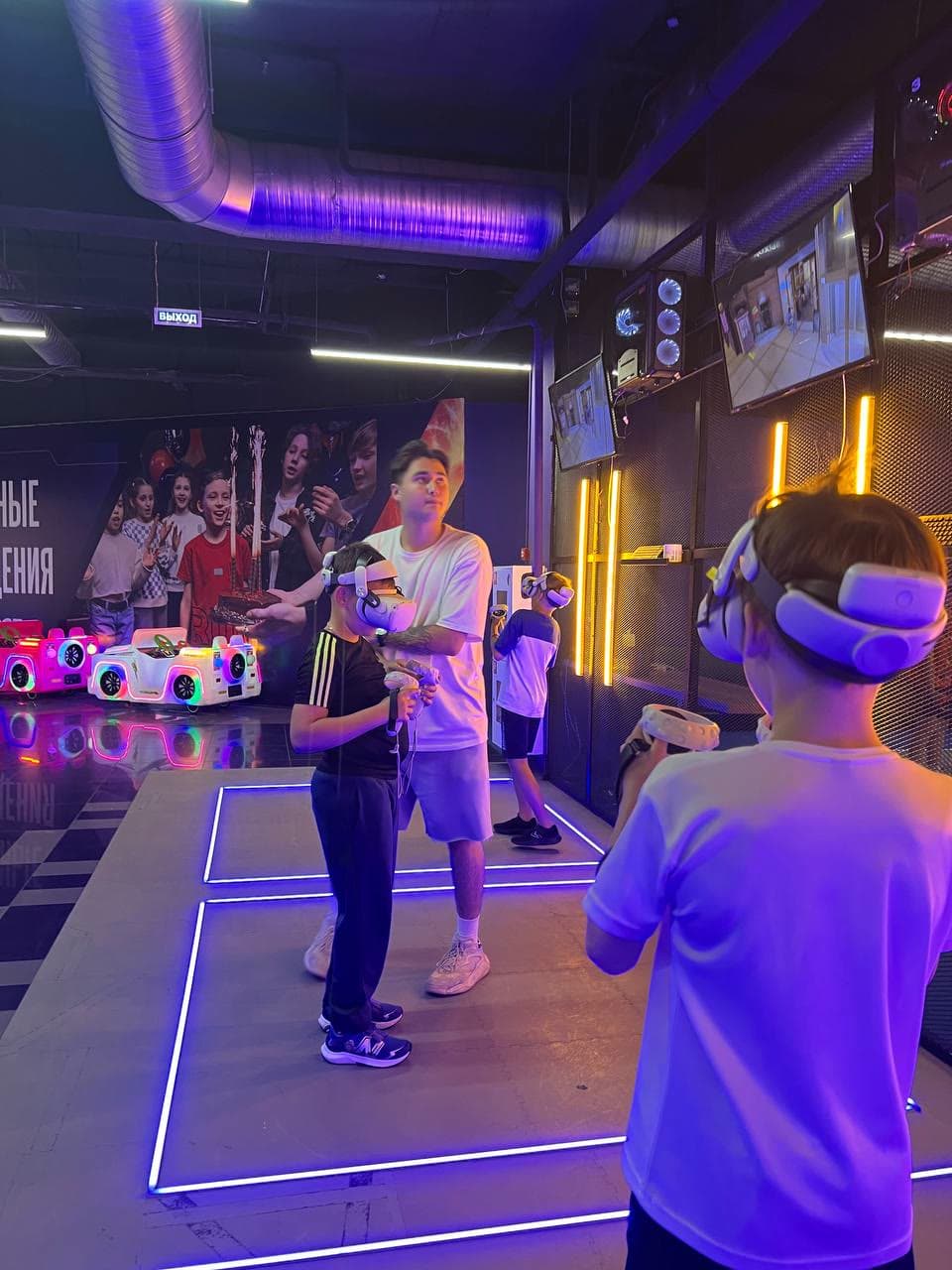
A VR arena in a shopping mall gives the owner a tenant whose guests arrive as planned groups, often book ahead and usually stay in the building longer than one game. It will not turn a weak mall around on its own, but it adds a reason to visit that online shopping can't replace, and it works in the evenings and at weekends when entertainment demand peaks. This article looks at the mechanics behind traffic and dwell time, and at how a mall can check whether an arena actually delivers them.
Why are malls looking at entertainment tenants at all?
Shopping is easy to move online; an evening with friends is not. That is the basic logic behind experiential retail, and it shows up in consumer research. In the ICSC Mix of Uses Survey (1,004 US adults, published April 2019), entertainment was named as a primary reason to visit physical locations by 61% of respondents, and dining by 53% (ICSC).
That is a US survey and it is several years old, so treat it as a direction, not a forecast for your mall. The direction is still useful: people come to physical places for experiences they can't get at home, and they eat while they are there. A free-roam VR arena is one of those experiences.
If you need the practical side first (space, power, which malls already host Metaforce arenas), it is on our VR arena for shopping malls page. Here we go deeper into what the owner gains and how to judge it.
How does a VR arena generate mall traffic?
It helps to separate three kinds of visits, because an arena affects each one differently.
| Type of visit | What an arena changes |
|---|---|
| Destination visit: the trip is planned around the arena | New visits the mall would not have had: a birthday group, a team after work, friends who booked a slot |
| Combined visit: the arena is one of several reasons | The arena tips the choice of mall: a family picks the mall where shopping, food and the kids' activity are in one place |
| Impulse visit: shoppers notice the arena while passing | Some walk-in play, but more often a future booking: people see the arena and come back for a party |
For the mall, the first type is the most valuable, because it is incremental. A free-roam arena is strong here for a simple reason: its main products are group products. Birthday party packages, corporate events and whole-arena rentals bring people who came specifically for the arena, at a time they chose in advance. On one Metaforce arena, 8 to 12 or more people play at once, and the total group per event can be larger, since some guests wait in the lounge.
A single booking therefore moves a group through the mall's doors, not one person. For a leasing manager, that is a different profile from most retail tenants.
Why does a VR arena increase dwell time?
Dwell time grows when a visit has several stages. A typical arena visit already does:
- Arrival and waiting. Groups rarely arrive at once. The early ones walk around the mall.
- The game itself. Arena time plus briefing and equipment.
- The lounge. Birthday and corporate packages usually include lounge time after the game. In our Russian arenas, packages run from 1 hour 45 minutes to 3 hours 45 minutes in total.
- After the event. Groups often go on to the food court, a café or the cinema. Parents of party guests who came to pick up their children sometimes arrive early and shop.
None of this is guaranteed, and we don't publish figures on how much extra time or spend an arena generates in a particular mall. What we can say is structural: an activity that takes two to four hours and involves a group creates more chances for food and retail spend than a 15-minute visit to a single store. Whether those chances turn into revenue depends on what sits next to the arena.
Where should the arena sit to maximize the effect?
Location inside the mall decides how much of the traffic spills over to other tenants.
- Next to food. Groups that just finished a game are hungry. A food court within sight of the arena exit is the simplest cross-sell a mall has.
- Inside an entertainment cluster. Cinema, kids' zones, bowling and VR together form a destination floor. Each one makes the others easier to find.
- Not next to quiet retail. Players are active and loud. A bookstore or a jewelry store next door will complain.
- On an upper floor, with wayfinding. Destination tenants can pull people upward, which helps upper-floor units. Metaforce arenas work from the lower ground floor to the fourth floor; signage and directions matter more than the floor number.
What should a mall owner measure?
If you want to know whether the arena brings traffic or just occupies space, agree on measurement before opening. Practical options:
| What to measure | How |
|---|---|
| Group bookings per week | The arena operator's booking system or CRM (Metaforce partners use the network CRM) |
| Peak hours | Compare the arena's busiest hours with the mall's footfall counters |
| Spillover to food | Joint offers, such as a food court discount shown with an arena receipt, and count redemptions |
| Repeat visits | Returning party guests and repeat corporate clients in the arena's CRM |
| Evening and weekend share | Footfall on the arena's floor before and after opening |
None of these needs special tools. They need an agreement with the operator to share basic numbers, which is worth putting into the lease discussion.
What does the mall risk?
An honest list, because a leasing decision should weigh both sides:
- The operator matters more than the concept. An arena that is badly run, understaffed or poorly marketed won't bring groups. Ask about the operator's experience and plan.
- Content gets stale. A VR attraction with the same games for years loses its regulars. With Metaforce, new maps or games arrive every 6 months and are included in the subscription, which addresses this directly.
- Noise and fit-out. The unit needs a level floor, ceilings from 2.5 m and 10–15 kW of power. Agree who brings the floor and power up to spec.
- Ramp-up time. Renovation, setup and the first months of local marketing take time. A fit-out period in the lease reflects that.
Should the mall run the arena itself or lease the unit?
Both models exist.
Leasing to an operator keeps the mall in its usual role. The mall collects rent; the operator carries the equipment, staff and marketing. This is the common case.
Running the arena through a company linked to the mall gives the mall the arena's revenue as well as the traffic, at the cost of running an entertainment business. With Metaforce, that does not require a classic franchise: the operator takes a subscription ($4,990 for 6 months, $7,990 for 12 months or $14,990 for 24 months, then $799 per month, taxes included) with no franchise fee, no royalty and no revenue share. The venue, renovation and equipment are paid separately, and equipment can be bought from any supplier. In Russia, Metaforce arenas start from RUB 2.5 million of investment and make RUB 500,000–1,500,000 a month in revenue depending on the city, the venue and occupancy. Details are on the franchise cost page, and the business side of running an arena is on VR arcade business.
In both cases, Metaforce rebuilds the game maps around the exact layout of the unit, so columns and an irregular plan don't automatically rule a space out. See VR arena design.
Where do Metaforce arenas already work in malls?
About 30 arenas in Russia, Kazakhstan, Israel and Slovakia run Metaforce games. Many of them are in shopping malls, such as MEGA Khimki, MEGA Belaya Dacha and MEGA Aksay, Fan Fan and Greenwich in Yekaterinburg, Goodwin in Tyumen and Arteria in Ufa. Others operate in standalone premises, so a mall is a common choice, not the only one.
How to start the conversation
If you own or lease space in a mall and want to know whether a unit fits a free-roam arena, send us the floor plan and the terms. We will tell you what the layout allows and how the maps would fit.
Related articles
- How to Choose a Location for a VR Arena: Mall, FEC or Standalone Venue
- Birthday Parties as a Key Revenue Line of a VR Arena: an Operator's View
- Seasonality of a VR Arena Business and How to Smooth It
FAQ
Does a VR arena really increase mall foot traffic?
It adds destination visits: groups that come specifically for a booked party, corporate event or game. How much that changes total footfall depends on the mall, its location and how well the arena is run. We don't publish traffic figures for specific malls.
Why does a VR arena increase dwell time?
A visit has several stages: arrival, the game, lounge time and often a meal afterwards. Packages in our Russian arenas last from 1 hour 45 minutes to 3 hours 45 minutes, which is longer than a typical shopping stop.
Is a VR arena an anchor tenant?
Not by size: a typical Metaforce arena occupies 150–250 m². It works as a destination tenant inside an entertainment cluster, next to food, cinema and kids' zones.
What data should a mall ask the operator to share?
Weekly group bookings, peak hours and repeat clients from the arena's CRM, plus the results of any joint promotions with food tenants.
Can a mall open a Metaforce arena itself?
Yes. Any operator, including a company linked to the mall, can take a Metaforce subscription and run the arena, with no franchise fee and no royalty.