
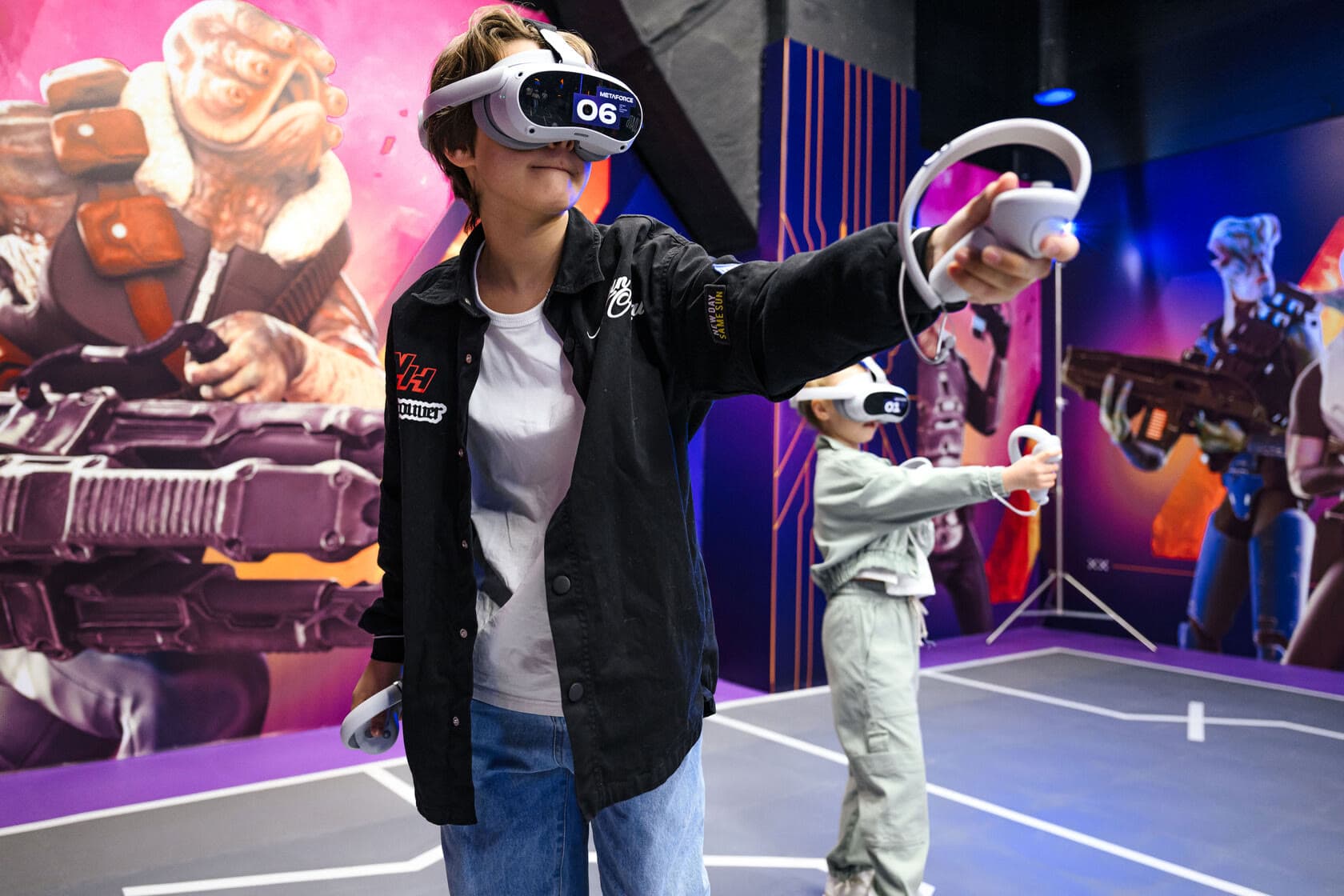
Selling corporate events from a VR arena is B2B sales: you find the people who organize events at local companies, reach them before they plan, give them a simple offer with a price and an invoice, and follow up after every event so the company returns. Done consistently, it fills weekday evenings that families and kids leave empty and creates a strong peak at the end of the year. This article covers the sales process step by step, the December season and how to structure packages for companies.
What a corporate VR event looks like on the arena floor (games, schedule, staffing and an example price ladder) is on our VR team building page. Here the focus is on how to win the booking.
Who actually buys a corporate event?
In most companies, there is no single "buyer". Know the roles:
| Role | What they care about | What to give them |
|---|---|---|
| Office manager or executive assistant | Easy to organize, clear price, an invoice, no surprises | A one-page offer, a fixed package price, fast answers |
| HR or people team | Engagement, inclusion, an activity everyone can join | Proof the games suit mixed groups and newcomers to VR |
| Team lead or department head | A fun evening for the team within budget | Simple packages by group size, weekday prices |
| Finance or accounting | Correct paperwork | Invoices and closing documents on time |
The person who sends the first inquiry is usually the organizer, not the decision maker. Make it easy for them to forward your offer internally: a PDF or a link with packages, photos and a price, not a request to "call us to discuss".
Where do corporate clients come from?
Corporate demand is local. Start with what is within a short drive of the arena.
- Your own guests. Adults who play at the arena work somewhere. Ask at checkout, or add a line to the booking form: "Planning a team event? We have corporate packages."
- Business centers and coworking spaces nearby. Many companies in one building, often with a shared community manager who promotes local offers.
- Mid-sized local employers. Banks, IT and service companies, retail chains, factories with office staff. Teams of 10–30 fit one arena event well.
- Parents from birthday parties. A parent who organized a child's party at your arena already trusts the venue.
- Search. Companies search for team building ideas and holiday party venues. A separate corporate page on your website, with packages and a form, captures that demand. With the franchise package, Metaforce partners get a website.
Track every lead in one place. With the franchise package, Metaforce partners use the network CRM, so a company's contact, past events and next reminder date stay in the system even when staff change.
What does the outreach sequence look like?
A simple, repeatable sequence beats occasional bursts of calls:
- Find the organizer. Office manager, HR or assistant. A business center's reception can often tell you who organizes events for each tenant.
- First contact. A short email or message: who you are, one sentence on what a VR team event is, the package range and a link to the offer. No attachments larger than a page.
- Follow-up after a week. One line, plus something useful: available December dates, or a weekday price.
- Invite to try. Offer the organizer a short trial game. An organizer who has played sells the event internally far better than any brochure.
- Proposal. After the inquiry, send a concrete proposal the same day: date options, package, price, what is included, payment terms.
- Confirm and invoice. Prepayment by invoice secures the date.
Keep the tone practical. Organizers are busy and judge you on speed and clarity.
Why is December the key season, and when should you start?
End-of-year parties are the most predictable peak in corporate entertainment: many companies hold some kind of year-end event, and some look for something different from another restaurant dinner. In our arenas, December is the peak month for corporate bookings. For a VR arena, that creates a short window when weekday evenings sell as well as weekends.
The catch is timing. Companies choose venues weeks before the event. If you start selling December in December, the best dates are already gone. A practical calendar:
| When | What to do |
|---|---|
| September–October | Prepare the year-end offer, update the corporate page, list target companies |
| October–November | Outreach to organizers, follow-ups, trial games for organizers |
| November | Confirm bookings and prepayments, plan staffing |
| December | Run events; offer gift certificates as employee gifts |
| January | Follow up with every December client; book spring and summer events |
Other occasions run through the year: company anniversaries, onboarding of new teams, the end of a project or a quarter, summer team days. The December list becomes the client base you work with for the rest of the year.
How should corporate packages be structured?
Companies compare offers quickly, so the structure should be obvious:
- Two or three packages by group size and duration. In our Yekaterinburg arenas, corporate events use the same S–XL package ladder as parties, from 1 hour 45 minutes to 3 hours 45 minutes in total, including lounge time.
- Weekday and weekend prices. A visible weekday discount steers corporate demand into quiet evenings and keeps weekends for parties.
- Whole-arena rental for large or custom events. In our Russian arenas, the whole arena costs about RUB 5,500–19,900 per hour, depending on the city and venue.
- Clear capacity. On one Metaforce arena 8 to 12 or more play at once, depending on the venue size. Larger groups rotate between the arena and the lounge, so the total guest count can be higher. Say this upfront; it answers the first question every organizer asks.
- Add-ons that cost you little. A tournament format with a final round, extra arena time, gift certificates for the winning team.
- Food on the client's side. Letting clients bring their own catering keeps your package simple and your price competitive.
Be ready for corporate paperwork: invoices, contracts where required and closing documents. Companies that can't get correct documents won't book twice.
How do you make the event sell the next one?
The event itself is your strongest sales tool:
- Mix competitive and cooperative rounds. Departments playing each other in TeamForce or Elevators, then everyone on one side. Zombies, a co-op survival game for 4–10 players, is coming soon and fits that shared-goal finale.
- Make it easy for newcomers. Many colleagues have never tried VR. Start with an easy game such as Portals. Players walk physically and their movement in the game matches real movement, so motion sickness is less common than in joystick-based VR, though staff should still offer breaks.
- Photos and results. Send the organizer photos and the scoreboard the next day. They will share them internally.
- New content for return visits. A company that played in spring wants something new in December. Metaforce adds new maps or games every 6 months, included in the subscription.
- Ask for the next date. The best time to sell the next event is right after a good one.
What does Metaforce provide, and what is up to the arena?
Metaforce provides the games, maps rebuilt around your venue's layout, launch support and staff training, a manager, a knowledge base with staff routines. With the franchise package, partners also get a website, the network CRM and a marketing kit. Local corporate sales are run by your team: the outreach, the proposals and the relationships with local companies.
The model is a subscription, not a royalty: $4,990 for 6 months, $7,990 for 12 months or $14,990 for 24 months, then $799 per month (taxes included), with no franchise fee, no revenue share and no marketing fee. That means a strong December doesn't increase what you pay us. See franchise cost, the wider business picture in VR arcade business and how the weekend party line complements corporate sales on VR birthday party.
Related articles
- Birthday Parties as a Key Revenue Line of a VR Arena: an Operator's View
- Seasonality of a VR Arena Business and How to Smooth It
- Staff for a VR Arena: Roles, Training and a Knowledge Base
FAQ
Who should a VR arena contact at a company?
The person who organizes events: usually an office manager, executive assistant or someone in HR. Give them a short offer they can forward internally.
When should an arena start selling year-end corporate events?
In October and November. Companies pick venues weeks ahead, so the best December dates go early.
How large a corporate group can one arena take?
On one Metaforce arena 8 to 12 or more play at once, depending on the venue size. Larger groups rotate between the arena and the lounge.
Should corporate events be priced differently from parties?
The package ladder can be the same; what matters is a visible weekday discount that steers companies to quiet evenings.
Does Metaforce find corporate clients for partners?
No. Local sales are run by the arena's team. Metaforce provides training and a manager to help set up the routines; with the franchise package, also the website, the network CRM and a marketing kit.