
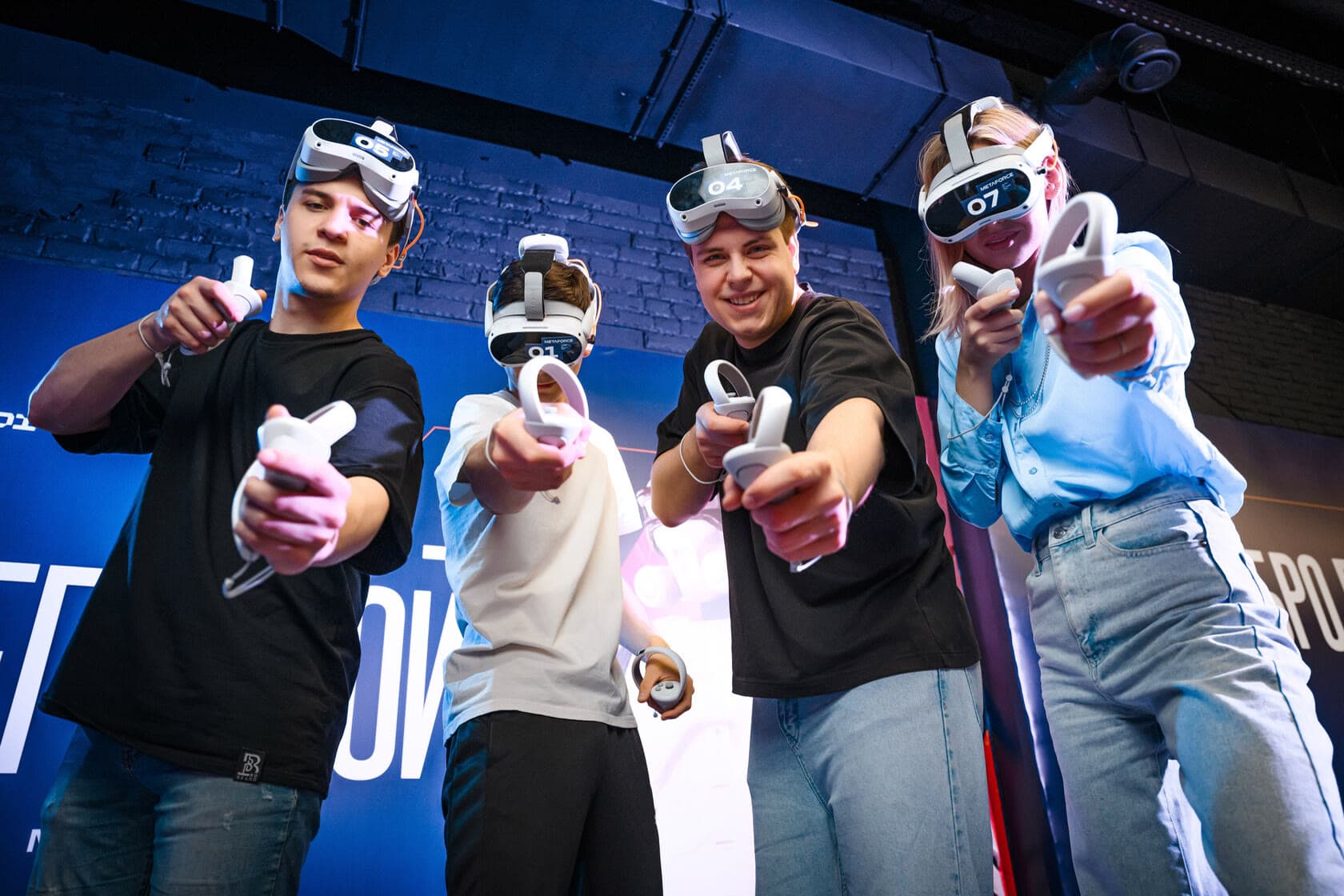
A VR arcade business sells time in virtual reality to groups: hourly sessions, private rentals, birthday parties and corporate events. Profit depends on the format, how many people play at once and how full your weekends and evenings are. In the Metaforce VR Arena network, arenas in Russia start from RUB 2.5 million of investment and pay back from about one year.
What formats does a VR arcade business use?
"VR arcade" covers two quite different businesses. Before you compare prices, decide which one you are building.
| Free-roam VR arena | VR booths / VR zone | |
|---|---|---|
| How people play | Walk freely across a large open space, in a team | Stand or sit in a small booth, often alone |
| Space | Play area of 50–300 m² (Metaforce) | A few m² per station |
| Players at once | 8 to 12 or more on one arena (Metaforce) | One per station |
| What you sell | A group experience: parties, team events, competitions | Short individual sessions |
| Typical customer | Groups of friends, families, companies | Walk-in mall traffic |
| Content | Multiplayer games built for the arena | Off-the-shelf single-player titles |
Booths are cheaper to start; a free-roam arena needs more space, but each booking brings a whole group. It is also the format where players move physically, so their movement in the game matches movement in the real world. Motion sickness is less common than with joystick movement, although it can't be ruled out for everyone. Read more in our guide to free-roam VR.
Metaforce VR Arena is a free-roam format. The rest of this page focuses on that model.
Where does a VR arena business get its revenue?
A healthy VR arena business does not rely on one product. Arenas in our network sell:
- Hourly play. Players pay per person per hour. In our Russian arenas, 1 hour per player costs from about RUB 800 to RUB 2,300, depending on city, day and time.
- Whole-arena rental. A group books the entire arena for a set time. In our Russian arenas this costs about RUB 5,500–19,900 per hour.
- Birthday party packages. Predictable weekend revenue booked ahead by parents.
- Corporate events and team building. Weekday and evening bookings, often for larger groups.
- Gift certificates. Cash comes in before the visit; with the franchise package, 12-month certificates are sold online.
A single game supports 4–20 players. On one arena, 8 to 12 or more people play at once depending on the venue size, and the total number of guests at an event can be higher because others wait in the lounge. That is what makes the group formats work: one booking fills the space.
What does it cost to start a VR arcade business?
The investment splits into four parts:
| Cost item | What it covers | Who you pay |
|---|---|---|
| Venue | Rent, deposit | Landlord |
| Renovation | Floor, walls, lighting, lounge, reception, power | Contractors |
| Equipment | Headsets, computers, tracking | Any supplier you choose |
| Content and know-how | Games, software, training, brand | Franchisor or content provider |
With Metaforce, partners in Russia start from RUB 2.5 million in total investment. The venue, renovation and equipment are paid separately; the content and support come with a subscription:
| Subscription term | Price (taxes included, paid upfront) |
|---|---|
| 6 months | $4,990 |
| 12 months (most popular) | $7,990 |
| 24 months | $14,990 |
| After the term | Another fixed term, or $799 per month |
There is no franchise fee, no revenue share, no marketing fee and no penalties. When the subscription ends, access to the games stops. See the full breakdown on franchise cost and why we chose this model on no-royalty franchise.
Venue requirements for a Metaforce arena: total venue 100–700 m², play area 50–300 m². The optimal setup is 150–250 m² in total with a 100–150 m² play area. You need 10–15 kW of power, a level floor and ceilings from 2.5 m. Details on layout are in VR arena design.
Are VR arcades profitable?
They can be, but not automatically. In the Metaforce network, arenas in Russia generate revenue of RUB 500,000–1,500,000 per month, depending on the city, the venue and occupancy, and payback starts from about one year. The same arena can sit at either end of that range depending on how it is run.
What moves an arena toward the top of the range:
- Occupancy at peak times. Friday evenings, weekends and school holidays carry the business. Count your bookable hours, not your opening hours.
- Share of group bookings. Birthdays, whole-arena rentals and corporate events fill the arena in one sale and are booked in advance.
- Content that brings people back. Repeat visits depend on new things to play. Metaforce releases new maps or games every 6 months, included in the subscription.
- Fixed costs you control. Rent is the biggest monthly item. A right-sized venue (150–250 m² total) usually beats a large, half-empty one.
- No revenue share. With a subscription, your fixed content cost does not grow as revenue grows. With a royalty model, it does.
- Staff routines. Fast session turnover, clean headsets and a well-run lounge directly affect reviews and repeat bookings.
What are the risks of a VR business?
Any honest look at VR business opportunities should include the downsides:
- Seasonality. Demand rises around holidays and school breaks and can dip in summer, especially in warm-climate cities where people spend time outdoors. Plan cash for the slower months.
- Dependence on mall traffic. A mall location brings walk-ins, but if the mall loses footfall, so do you. A destination format built on bookings (parties, corporate events) is less exposed than one relying only on passers-by.
- Headset wear. Headsets are used for hours every day by many people. Expect wear on straps, face pads, controllers and cables, and budget for replacements. Our knowledge base covers headset care, but wear cannot be avoided entirely.
- Content fatigue. If nothing new appears, regulars stop coming. This is why updates matter more than the size of the launch library.
- Staffing. A VR arena is a service business. A weak game master spoils a great game.
What do you get with Metaforce VR Arena?
Metaforce started in Yekaterinburg, where we still run 2 arenas of our own. Today the network has about 30 arenas in 4 countries (Russia, Kazakhstan, Israel and Slovakia) and works in cities from 20,000 residents.
Partners receive:
- 5 released games developed in-house: TeamForce, StarForce, Elevators, Portals and Mini Games for kids and families (6+), with Zombies coming soon;
- maps rebuilt around the exact layout of your venue;
- launch support, staff training and a manager who stays on hand;
- a knowledge base: equipment setup, cash handling, staff routines, CRM and headset care;
- with the franchise package: a website, the network CRM and a marketing kit;
- new maps or games every 6 months.
If you are comparing several VR gaming business ideas, see our VR franchise comparison and the equipment guide.
How do you start a VR arcade business with Metaforce?
Starting a VR arcade business with us takes five steps:
- Apply and tell us your city and venue options.
- Check the venue against the requirements: area, ceilings, power, floor.
- Choose a subscription term and order equipment from the supplier you prefer.
- Renovate and set up, while we adapt the game maps to your layout.
- Train the team and launch, with our manager on hand.
Apply now and we'll look at your city and venue together.
FAQ
Are VR arcades profitable?
They can be when occupancy is high and group bookings make up a large share of sales. In the Metaforce network, arenas in Russia make RUB 500,000–1,500,000 in monthly revenue depending on city, venue and occupancy, with payback from about one year.
How much does it cost to start a VR arcade business?
For a Metaforce arena in Russia, investment starts from RUB 2.5 million. This covers the venue, renovation and equipment, which you pay separately, plus a games subscription from $4,990 for 6 months.
How much space does a VR arena need?
A Metaforce arena needs a total venue of 100–700 m² with a play area of 50–300 m². The optimal size is 150–250 m² in total with a 100–150 m² play area, ceilings from 2.5 m and 10–15 kW of power.
What is the difference between a VR arena and VR booths?
In a free-roam arena a team walks freely across a large space and plays together; in booths people play individually. Arenas sell group experiences, booths rely more on walk-in traffic.
Do I pay royalties with Metaforce VR Arena?
No. Metaforce works by subscription: no franchise fee, no revenue share, no marketing fee and no penalties. The chosen term is paid upfront; after it, you buy another fixed term or continue at $799 per month.
Can I use my existing VR equipment?
Equipment can be bought from any supplier. Compatible headsets include Meta Quest 2, Meta Quest 3, Meta Quest 3S, PICO 4 and PICO 4 Ultra; if you already have equipment, mention it in your application.