
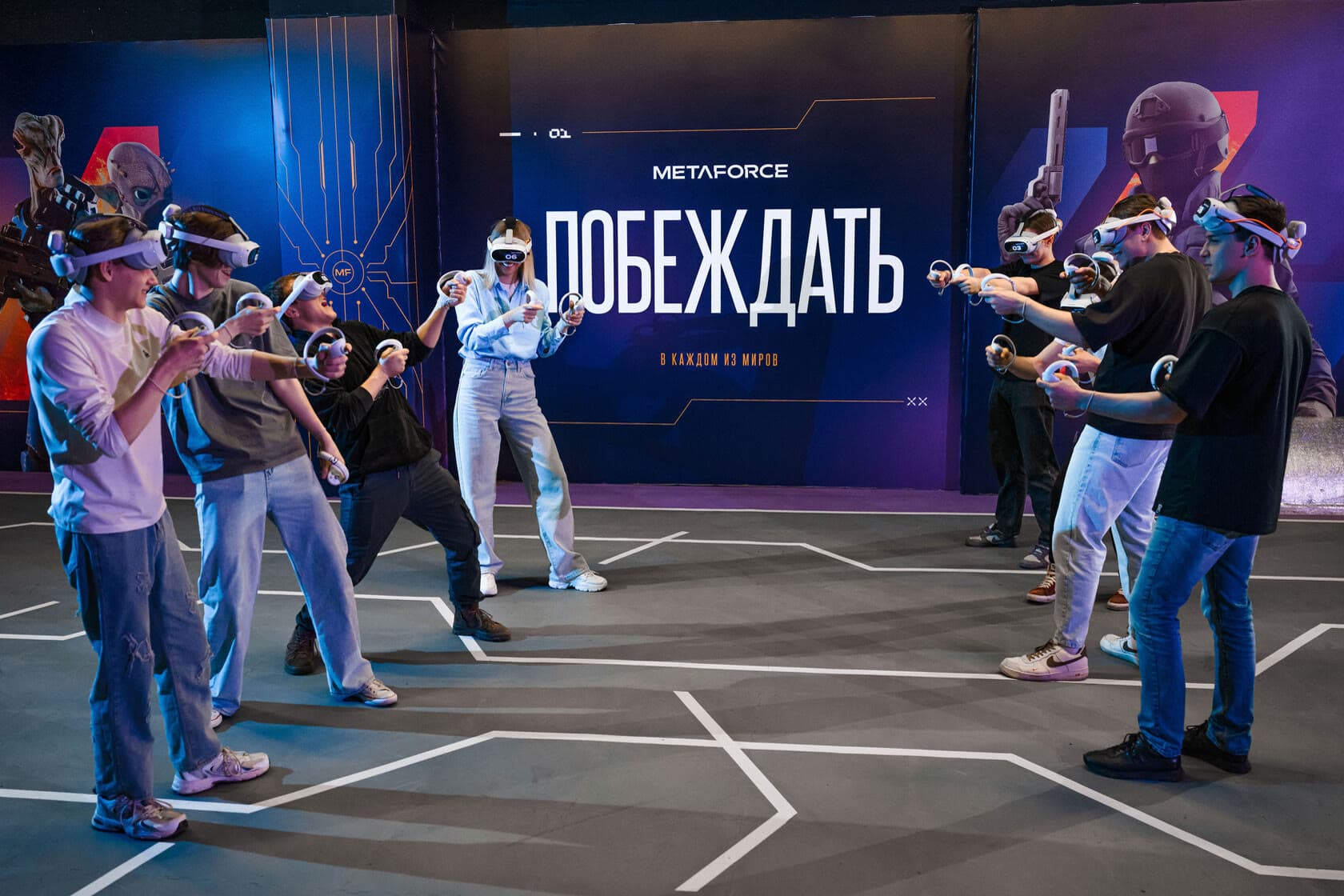
VR arcades can be profitable, but profit comes from occupancy and group bookings, not from the headsets themselves. In the Metaforce VR Arena network, arenas in Russia generate RUB 500,000–1,500,000 in monthly revenue depending on city, venue and occupancy, start from RUB 2.5 million of investment and pay back from about one year. Whether a particular arena lands at the bottom or the top of that range depends on a handful of drivers that the owner controls.
This article explains those drivers and how to test them for your own venue. The overall business model is on the VR arcade business page; here we focus on one question: what makes the difference between a marginal arena and a profitable one.
What numbers does the Metaforce network actually publish?
Metaforce games run in about 30 arenas in 4 countries: 21 Metaforce-branded arenas and 10 partners who use our games under their own brand. Most of the network is in Russia, and that is the only market for which we publish economics:
| Metric (arenas in Russia) | Figure |
|---|---|
| Investment to open | From RUB 2.5 million |
| Monthly revenue | RUB 500,000–1,500,000 |
| Payback | From about one year |
Three caveats, stated plainly:
- These are ranges, not a promise. The spread from RUB 500,000 to RUB 1,500,000 is a factor of three. The same format produces both ends.
- These are revenue figures, not profit. Rent, wages and other costs differ by city, so we do not publish a single margin.
- They apply to Russia. In another country, rent, wages, equipment prices and consumer prices change the picture. Use them to understand the model, not as a forecast.
We don't publish per-arena results, averages across the network or figures for other countries, and we would be wary of anyone who quotes a single "typical profit" for VR arcades in general.
What does RUB 500,000 or RUB 1,500,000 a month mean in practice?
A revenue figure becomes useful when you translate it into bookings. As an illustration, take the consumer prices in our Russian arenas: one hour of play per player from about RUB 800 to RUB 2,300, and the whole arena from about RUB 5,500 to RUB 19,900 per hour.
If we assume, purely for illustration, an average of RUB 1,500 per player-hour:
| Monthly revenue | Player-hours needed at RUB 1,500 (illustrative) | Per day over 30 days |
|---|---|---|
| RUB 500,000 | about 333 | about 11 |
| RUB 1,500,000 | 1,000 | about 33 |
Or, if all revenue came from whole-arena rentals at an illustrative RUB 10,000 per hour:
| Monthly revenue | Rented arena-hours at RUB 10,000 (illustrative) |
|---|---|
| RUB 500,000 | 50 |
| RUB 1,500,000 | 150 |
Real arenas sell a mix of formats at different prices, so these numbers are not a plan. They show something more useful: the gap between the bottom and the top of the range is not a mysterious "market factor". It is the difference between roughly 50 and 150 busy arena-hours a month, or a few groups a day versus a full weekend schedule plus weekday events. That is something you can plan, measure and manage.
Which drivers move an arena from the bottom of the range to the top?
1. Occupancy in peak hours
A VR arena does not earn evenly across opening hours. Friday evenings, weekends and school holidays carry most of the revenue. The key metric is not "hours open" but "peak hours sold". An arena that sells out its weekends and fills a few weekday evenings will outperform one that is half-full all week, even with lower prices.
2. The share of group bookings
Free roam is a group format. A single game supports 4 to 20 players, and on one arena 8 to 12 or more people play at once depending on the venue size. A birthday party, a whole-arena rental or a corporate event fills that capacity in one sale, often booked days or weeks ahead. Walk-in sales are welcome, but an arena that depends on them alone has a much less predictable month. How operators build these lines is covered in VR birthday parties and VR team building.
3. Average check per visit
The same group can spend very different amounts. An hour of play is one product; a birthday package with lounge time, an extended session or a gift certificate is another. Arenas in our network sell hourly play, whole-arena rentals, birthday packages, corporate events and gift certificates (in Metaforce-branded arenas they are valid for 12 months and sold online). Gift certificates bring cash in before the visit, which also helps in slower months.
4. Rent relative to capacity
Rent is usually the largest fixed cost. Profitability depends less on how big the venue is and more on whether its size matches demand. For Metaforce the optimal format is 150–250 m² in total with a 100–150 m² play area. A larger venue raises capacity, but if that capacity is only used on Saturdays, the extra rent works against you every other day.
5. Content that brings guests back
Repeat visits are the cheapest revenue an arena has. They depend on having something new to play. Metaforce releases new maps or games every 6 months, included in the subscription, and all games are developed in-house. Five games are released today, with Zombies coming soon.
6. Fixed franchise costs
With a royalty model, the franchisor's share grows as your revenue grows. With a subscription, your content cost is fixed: the chosen term is paid upfront, and after it you buy another fixed term or pay $799 per month (taxes included), whether the month is quiet or record-breaking. In a strong month, the difference stays in the business. The flip side is that the fee is due in a quiet month too. We look at that cash-flow effect in detail in royalty vs subscription.
7. Staff and operations
A VR arena is a service business. Fast changeover between rounds, clean and charged headsets, a game master who keeps the group engaged and a well-run lounge all show up in reviews, repeat visits and referrals. The Metaforce knowledge base covers equipment setup, cash handling, staff routines, CRM and headset care, but the daily standard is set by the owner's team.
What lowers profitability?
An honest answer also lists what pulls arenas toward the bottom of the range:
- Seasonality. Demand rises around holidays and school breaks and can dip in summer. Fixed costs don't dip with it.
- Weak location for the chosen sales model. A hidden unit with no booking strategy, or a prime mall unit paying premium rent without converting foot traffic into parties.
- Oversized venue. Paying for square meters that are rarely used.
- Equipment downtime. Headsets and controllers wear out. Without spares, a broken part can cost a booking.
- Slow ramp-up. Group bookings build over weeks. Owners who open without working capital are forced to cut corners at exactly the wrong time.
How can you check profitability for your own venue before investing?
Use a simple model and fill it with local numbers:
Monthly profit = revenue − rent − wages − subscription − other running costs
Payback (months) = total investment ÷ monthly profit
Then stress-test it:
- Price your products. Find local prices for comparable group entertainment: hourly play, private hire, party packages.
- Estimate peak hours. Count the evening and weekend hours you can realistically sell, then add weekday corporate and school-holiday demand.
- Run three scenarios. A slow month, a normal month and a strong month. If the slow month can't cover fixed costs, look again at rent or venue size.
- Check the payback in the slow scenario. A plan that only works in the best case is not a plan.
A full structure for this is in our VR arcade business plan guide, and the cost side is broken down in how much it costs to open a VR arcade.
Is a VR arcade a good investment?
It can be a solid one for an owner who treats it as a service business with a sales plan, not as a room full of technology. The format has clear strengths: group bookings, event revenue, prepaid gift certificates and content that keeps guests coming back. It also has real risks: seasonality, fixed rent and equipment wear.
Metaforce's role is to remove part of the risk on the content and know-how side: venue-specific maps, training, a manager and regular updates, for a fixed subscription with no revenue share, plus the network CRM with the franchise package. The rest, the venue, the team and local sales, is the owner's business, which is exactly why we don't take a percentage of it.
Related articles
- How Much Does It Cost to Open a VR Arcade in 2026? A Line-by-Line Budget
- Seasonality of a VR Arena Business and How to Smooth It
- Free-Roam VR vs VR Arcade Booths: Which Format Earns More per Square Meter?
FAQ
Are VR arcades profitable?
They can be when peak hours are full and group bookings make up a large share of sales. Metaforce arenas in Russia generate RUB 500,000–1,500,000 in monthly revenue, depending on city, venue and occupancy, with payback from about one year.
How much profit does a VR arcade make?
We don't publish a single profit figure: rent and wages differ too much by city. We publish revenue ranges and payback for Russia; use them with your own local costs.
How long does it take for a VR arena to pay back?
For Metaforce arenas in Russia, from about one year, with investment starting from RUB 2.5 million.
What is the main factor in VR arcade profitability?
Occupancy in peak hours, driven mostly by group formats such as birthday parties, whole-arena rentals and corporate events.
Do these figures apply outside Russia?
Not directly. They show how the model works, but rent, wages and consumer prices in your country will change the result.
Does Metaforce take a share of revenue?
No. Partners pay a flat subscription with no royalty, no revenue share and no marketing fee.
Apply now and we'll go through the numbers for your city and venue.