
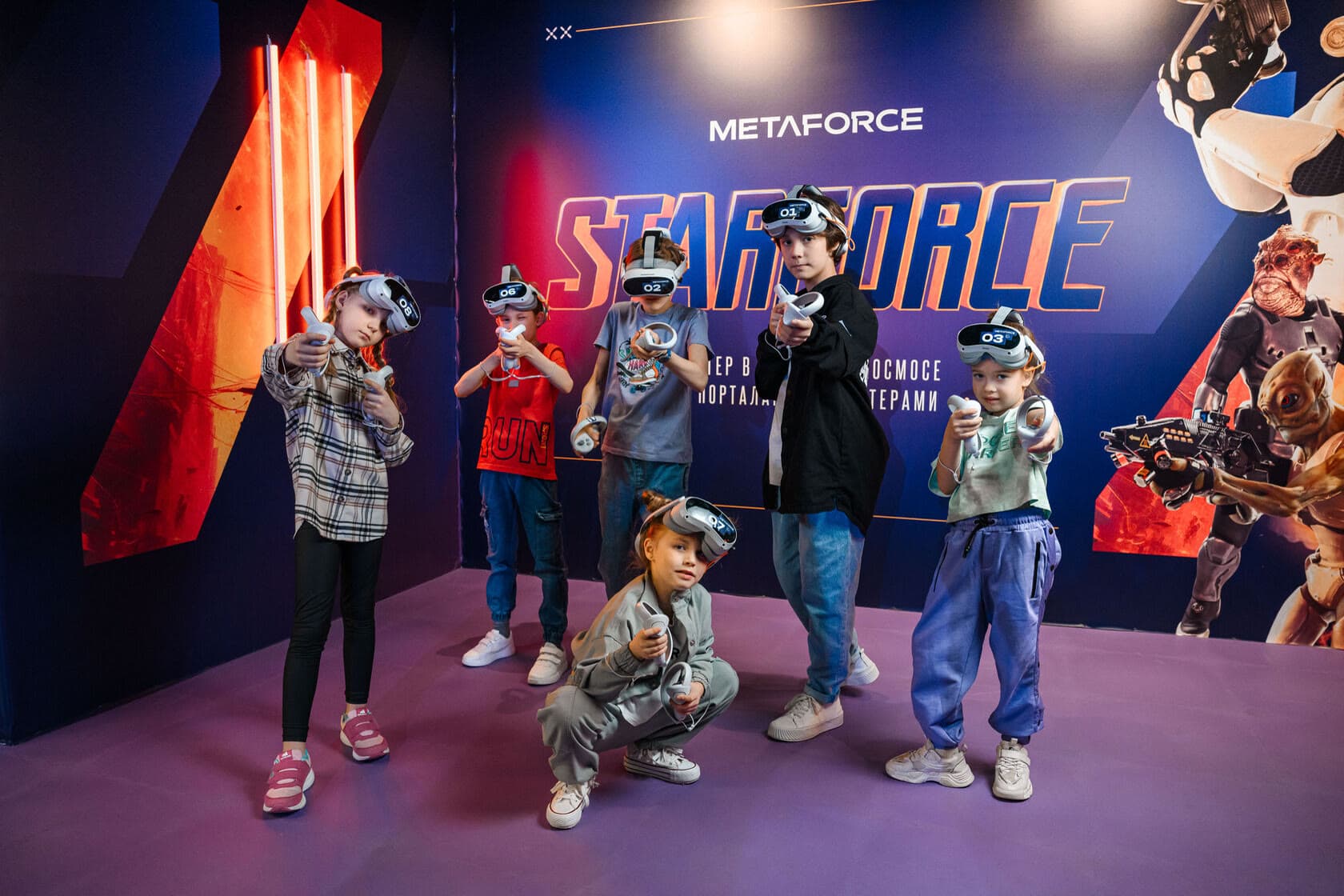
How often should a VR arena update its games? A practical rhythm is something new on the floor at least twice a year, plus a library that already covers your main customer groups. At Metaforce VR Arena, new maps or games arrive every 6 months and are included in the subscription, so partners don't buy each update separately.
This article looks at the question from the operator's side: why content goes stale, what counts as a real update, and how to turn each release into bookings.
Why does game content matter for a VR arena business?
A VR arena sells experiences, not equipment. Guests don't come back for a better headset; they come back for a game they haven't played yet or a map they want to master. Content drives both halves of the revenue:
- First visits. A first-time group mostly cares that the experience looks exciting and suits their age and mood. Several genres in the line-up make it easier to say yes to more groups.
- Repeat visits. Regulars, school-age kids, groups of friends and corporate clients who already came once need a reason to book again. "We've already done that" is the most common reason a group picks a different venue next time.
That is why content fatigue appears in almost every VR business plan as a risk next to seasonality and equipment wear. If the line-up never changes, the arena slowly depends on first-time guests only, and that pool shrinks as the local market gets to know you.
How often should a VR arena update its games?
There is no industry standard, but the logic is simple. Your most loyal customers set the pace. Regular players and repeat birthday groups often return within a few months. If they find the same games every time, the second or third visit loses its appeal.
A useful frame for an operator:
| Content horizon | What it does for the business |
|---|---|
| Launch library | Covers your main segments from day one: teams, families, kids, corporate groups |
| New maps for existing games | Keeps regulars engaged in games they already like |
| New games | Opens new segments and creates a marketing moment |
| Regular, predictable cycle | Lets you plan promotions and tell customers "something new is coming" |
The Metaforce cycle is new maps or games every 6 months, included in the subscription. Two content moments a year give the arena a steady reason to contact past customers without paying for each release.
What counts as a real update?
Not every change is worth announcing. From a guest's point of view, an update matters when it changes what happens on the arena:
- A new game. A new genre or mode, for example a co-op game where the whole group plays on one side instead of against each other.
- A new map. New routes, new cover, a different pace. In a tactical shooter a new map changes how teams play.
- A new format for a segment. A kid-friendly game, for instance, opens birthday parties for younger children.
Bug fixes and small balance changes are important for quality, but they are not a reason for a guest to book. Plan your marketing around the first three.
What does the Metaforce line-up look like today?
Metaforce develops its games in-house, so there are no off-the-shelf licences to buy and renew. Five games are released, and a sixth is coming soon:
| Game | Format | Maps / games | Age |
|---|---|---|---|
| TeamForce | Tactical team shooter | 10 maps | 7+ |
| StarForce | Space shooter with teleports | 4 maps | 7+ |
| Elevators | Multi-level shooter | 2 maps | 7+ |
| Portals | Arcade shooter with portals | 3 maps | 7+ |
| Mini Games | Kids and family collection | 3 games | 6+ |
| Zombies (coming soon) | Co-op survival | 3 maps | 9+ |
A game supports 4 to 20 players (Zombies: 4 to 10). Each map is rebuilt around the exact layout of the partner's venue, so new content fits your play area, not a generic room. More detail is on the VR arena games page and the TeamForce page.
Why do maps need to be adapted to each venue?
A free-roam arena has its own shape: columns, corners, an entrance on one side. Generic content forces the operator either to find a room that matches the game or to accept a smaller play area. When the maps are rebuilt around the venue, every update arrives ready for your floor. That matters for the update cycle: if each new map required a renovation or a change in layout, operators would skip updates, and the content would go stale anyway. You can read more about layouts in VR arena design.
How do new games bring guests back?
An update only brings revenue if your customers know about it. A simple routine for each release:
- Prepare before release. Brief your staff on the new game: rules, age rating, how to explain it in 30 seconds at the briefing.
- Contact past customers. Use your CRM to reach previous birthday clients, corporate contacts and regulars. A message like "new game in our arena" is one of the few reasons to write to a past customer that isn't a discount.
- Update your packages. Add the new game to birthday and corporate offers. A co-op game, for instance, fits team building well.
- Show it. Short videos and photos from the first sessions in your own arena work better than generic trailers.
- Watch the bookings. Compare booking volume from repeat customers before and after the release, and note which groups came back.
With the franchise package, Metaforce partners work in the network CRM and get a marketing kit, so the customer base and the materials are already in one place.
What happens to content when you buy games one by one?
Some operators buy individual titles or licences and plan updates themselves. That can work, but it changes the economics:
- Every new title is a separate purchase decision, so updates tend to be postponed when cash is tight, which is exactly when the arena needs a reason for guests to return.
- Content from different studios may not be adapted to your layout.
- The arena has to track licence terms for each game.
In the Metaforce model, content is part of a subscription with no franchise fee and no royalties: $4,990 for 6 months, $7,990 for 12 months or $14,990 for 24 months, then $799 per month, taxes included. New maps or games every 6 months are included. When the subscription ends, access to the games stops, so it's worth planning the term with that in mind. Full terms are on the franchise cost page, and the model is explained on the no-royalty franchise page.
Can an update replace good operations?
No. A new map will not save an arena with dirty headsets, slow check-in or a weak briefing. Updates work best on top of solid routines: clean equipment, fast session turnover and staff who know how to run a game. The Metaforce knowledge base covers equipment setup, cash handling, staff routines, CRM and headset care, and new partners get launch support and staff training.
How should you plan content in a VR arena business plan?
In your plan, treat content as a recurring line, not a one-off purchase:
- Launch library: which segments it covers.
- Update cycle: how often new content arrives and what it costs. With Metaforce, the cost is inside the subscription.
- Marketing per release: a small budget and a routine to tell past customers.
- Risk: what you will do if content fatigue shows up in repeat bookings.
A step-by-step template is in the VR arcade business plan guide.
Related articles
- Royalty vs Subscription: Why Metaforce VR Arena Doesn't Take a Share of Partner Revenue
- Kids' VR Content for Arenas: Age Limits, Safety and Mini Games
- Seasonality of a VR Arena Business and How to Smooth It
FAQ
How often does Metaforce release new content?
New maps or games arrive every 6 months. They are included in the subscription, with no extra charge per release.
How many games does Metaforce have now?
Five released games: TeamForce, StarForce, Elevators, Portals and Mini Games. Zombies, a co-op survival game, is coming soon.
Do new maps fit my venue?
Yes. Metaforce rebuilds each map around the exact layout of the partner's venue.
Do I need to buy game licences separately?
No. The games are developed in-house and come with the subscription. Equipment is bought separately from any supplier.
What happens to the games if I stop the subscription?
When the subscription ends, access to the games, the Metaforce brand, the website and the CRM stops; your equipment stays yours. Before that point, when a term ends, you can buy another fixed term or continue month to month at $799 per month, and after a break you can renew the subscription later.
Is a big launch library more important than regular updates?
Both matter, for different guests. The launch library wins first visits; regular updates bring back the customers you already have.