If you are looking at a go kart franchise, you are looking at one of the most recognizable formats in indoor entertainment: electric karts, a timed track and a strong party and corporate business. A free-roam VR arena sells to many of the same groups but is built very differently. This article compares the two on investment, space, fleet, safety, fees and staff using public figures checked in October 2026, and asks whether a VR arena can work as an extra attraction inside a karting center.
We are Metaforce VR Arena, so this is not a neutral review. Karting is a strong business, and we say where it has the edge. We also state one fact up front: there are no Metaforce arenas inside karting centers today, so the add-on section describes how it would work, not a track record.
How do an indoor go kart business and a VR arena compare at a glance?
| Indoor electric karting | VR arena (Metaforce VR Arena) | |
|---|---|---|
| Investment | Commercial indoor facility $420,000–$1,500,000+ (karting software vendor estimate, 2026) [4]; $300,000–$1.5 million+ for a go-kart franchise (software vendor guide) [6] | From about $30,000 (RUB 2.5 million at the Bank of Russia rate on 14 October 2026; arenas in Russia) |
| Building | 30,000–60,000 sq ft with generous ceiling height (vendor estimate) [4][5]; 20,000–50,000+ sq ft (vendor guide) [6] | 100–700 m² total (about 1,080–7,530 sq ft); play area 50–300 m² (about 540–3,230 sq ft); ceilings from 2.5 m (about 8 ft) |
| Core equipment | Electric rental karts $5,000–$12,000+ each; a 15–30 kart fleet $100,000–$360,000 [4] | Headsets, computers and tracking, bought by the partner from any supplier |
| Franchise fee | $30,000–$150,000+ (vendor guide range) [6]; $39,500 for Drift Zone, a kart-drifting brand (aggregator) [3] | None |
| Ongoing fees | Royalty based on revenue [6]; Drift Zone 5% royalty plus 1% marketing fee (aggregator) [3] | No royalty, no marketing fee; subscription $4,990 / 6 months, $7,990 / 12 months or $14,990 / 24 months, taxes included, paid upfront; then another term or $799/month |
| Insurance | Commercial liability and workers' comp $15,000–$30,000+ per year (vendor estimate) [4] | Ask your broker; there are no vehicles on site |
| Guest limits | US example: junior karts from 48 in tall, adult karts from 58 in, up to 300 lbs [7] | Shooters 7+, Mini Games 6+, Zombies (coming soon) 9+ |
| Capacity | A 10-kart grid with 3–4 rotations an hour serves 30–40 drivers [4] | 4–20 players per game |
Karting figures come mostly from guides by companies that sell software to karting tracks [4][5][6]. They are planning estimates, not FDD data.
Is there a go kart franchise you can buy in the US?
Fewer than you might expect. K1 Speed, the largest indoor karting operator, says on its franchise page that it is currently not franchising in the United States; it offers franchises outside the US and asks for at least $500,000 in liquid assets and a $1.8 million net worth [1]. K1 Speed grows largely through its own centers and acquisitions: in January 2024 it bought 11 Autobahn and Accelerate Indoor Speedway locations and said it then operated 83 locations in 29 states and seven countries [2].
Other large brands are destination venues: Andretti's Overland Park, Kansas center (opened November 2025) is an 84,000 sq ft building with superkarts, VR, racing simulators, laser tag, duckpin bowling and a restaurant [8]. We did not find a public Andretti FDD, so we quote no investment figure.
The one karting-related franchise with public Item 7 data we found is Drift Zone, a go-kart drifting format: $269,500–$598,000 total investment, a $39,500 franchise fee, a 5% royalty and a 1% marketing fee, with 2 company-owned units and franchising since 2023, according to an FDD aggregator [3]. The aggregator shows two FDD years, so check the current filing.
In practice, many people asking how to start a go kart business end up building an independent track with a manufacturer and a software vendor, not buying a franchise.
What does a go kart track cost?
The answer depends mostly on the building. BMI Leisure, which sells timing and booking software to karting centers, puts a commercial indoor facility at $420,000–$1,500,000+ and adds $375,000–$850,000 for a multi-level steel track structure [4]. ROLLER, another venue software company, gives $100,000 to $1 million for track design and construction alone [9].
The fleet is a recurring cost of its own: $5,000–$12,000+ per electric rental kart, and 15–30 karts per track [4]. Then come barriers, timing, safety gear and insurance of $15,000–$30,000+ a year [4].
Metaforce does not publish a US investment figure. In Russia, owners typically invest from RUB 2.5 million in total, about $30,000 at the Bank of Russia rate on 14 October 2026; that reflects Russian prices and is not a US forecast. The full breakdown is on franchise cost.
Where is the go kart business strong?
An honest comparison starts with what karting does well:
- A clear product. Driving a fast kart needs no explanation, and lap times give every race a winner.
- High hourly throughput on a big track. A 10-kart grid running 3–4 rotations an hour serves 30–40 drivers [4], at $20–$50 per driver in the vendor's estimate [4]. A US K1 Speed location lists a single walk-in race at $31, plus an $8.50 annual license [7].
- Year-round. Indoor tracks operate 365 days a year [5].
- An anchor for food, arcade and parties. Indoor tracks sell F&B, arcade time, party rooms and corporate events around racing [5]. When K1 Speed took over the Autobahn sites, it added a café and an arcade to each one [2].
Where does karting carry more risk?
Capital and building. Karting needs a warehouse-format building, often 30,000 sq ft or more [4][5], with a long lease and heavy electrical work.
A fleet that wears. Karts, tires, batteries and barriers need constant maintenance and replacement. A VR arena has hardware too, but no vehicles.
Height and age limits. At a US K1 Speed location, junior karts need a driver at least 48 in tall and adult karts at least 58 in [7]. Younger children in a family group often watch rather than drive. Metaforce Mini Games start at 6+ and the shooters at 7+.
Safety and insurance. Moving vehicles mean waivers, marshals, and insurance of $15,000–$30,000+ a year in one vendor estimate [4]. ROLLER recommends at least one certified first aider on every shift [9].
How do space and staff compare?
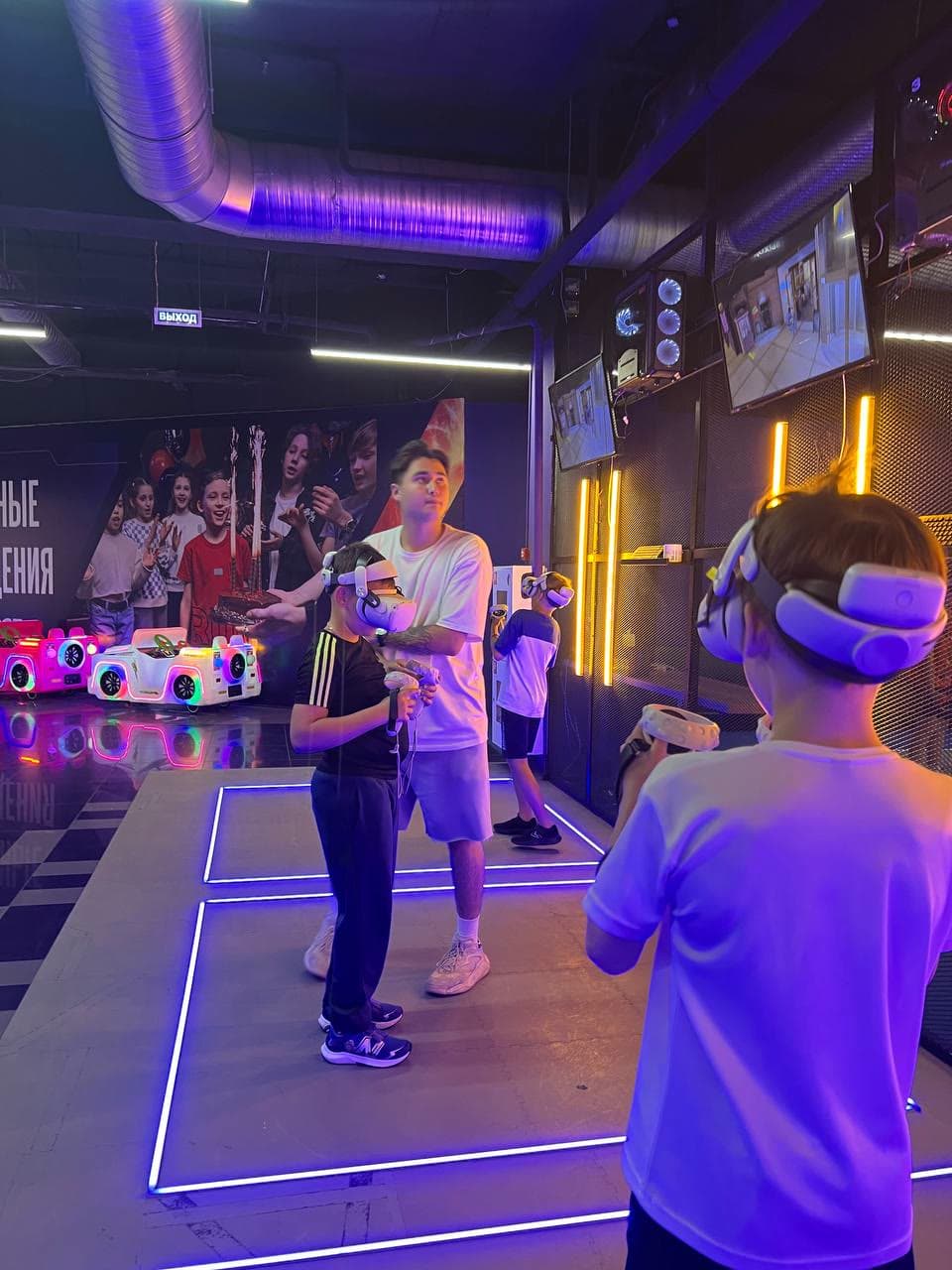
A VR arena needs an open, level floor rather than a track: a play area of 50–300 m² (about 540–3,230 sq ft), with an optimal venue of 150–250 m² in total and a 100–150 m² play area, ceilings from 2.5 m and 10–15 kW of power. There are no barriers, sets or props; maps are adapted to the layout of the room.
The karting guides we checked give no staff headcounts; a track needs marshals, a front desk, kart maintenance and a manager on duty. In Metaforce arenas the team is 2–3 people per day: a manager, game masters and reception. More is in our VR arcade business plan guide.
How do fees compare?
Go-kart franchise fees run from $30,000 to $150,000+ in one vendor guide, with royalties based on revenue [6]; Drift Zone shows 5% plus a 1% marketing fee [3]. The brand's share rises in your best months.
Metaforce charges no franchise fee, no royalty and no marketing fee, only the subscription: $4,990 for 6 months, $7,990 for 12 months or $14,990 for 24 months, taxes included and paid upfront, then another term or $799/month. New maps or games arrive every 6 months, included. The reasoning behind the model is on no-royalty franchise.
Can a VR arena be an add-on attraction for a karting center?
Large karting venues already pair the track with other attractions: Andretti's Overland Park center lists VR and simulators next to its superkarts [8], and K1 Speed adds arcades to acquired sites [2]. Not everyone in a group drives, and a second attraction gives guests something to do between races.
A Metaforce arena is one way to add a group attraction inside a karting building:
- Space. A play area of 50–300 m² fits inside a building of 30,000 sq ft or more, using a side hall, a former party room or a mezzanine with ceilings from 2.5 m.
- Shared infrastructure. Inside a host venue a separate lounge is not required; guests can wait in your existing lobby and use your café and party rooms. Power needs are 10–15 kW.
- Different guests. Children too short for the karts can play Mini Games from 6+, and team shooters from 7+ work for parties and corporate groups.
- Packages. One booking can combine a race and a VR match for 4 to 20 players per game.
About 30 arenas in 4 countries run Metaforce games, including our own 2 arenas in Yekaterinburg. None are inside karting centers yet, so a karting owner would be among the first; we will plan the layout with you. Similar add-on cases are covered in VR arena for trampoline parks and family entertainment center.
How to start a go kart business or a VR arena: questions for your plan
- Building. Can you lease 30,000+ sq ft for a track, or do you have a 1,000–3,000 sq ft unit?
- Fleet. What will karts, batteries and barriers cost to replace over five years?
- Fees. What will you pay the brand over 3 and 5 years at your expected revenue?
- Guests. Who in a typical family or party group cannot drive, and what do they do?
For a wider view of formats, see our entertainment franchise comparison.
Apply now and send us your floor plan; we will tell you what fits.
FAQ
How much does a go kart franchise cost?
One vendor guide puts a go-kart franchise at $300,000 to $1.5 million+, with franchise fees of $30,000–$150,000+. Drift Zone's filing shows $269,500–$598,000. Confirm with the current FDD.
Does K1 Speed sell franchises in the US?
Its franchise page says it is currently not franchising in the United States; it offers franchises abroad.
How much space does an indoor go kart business need?
Industry guides give roughly 20,000–60,000 sq ft. A Metaforce venue needs 100–700 m² in total (about 1,080–7,530 sq ft).
Are there Metaforce arenas inside karting centers?
Not yet. About 30 arenas in 4 countries run Metaforce games, none of them inside a karting center.
Sources
Checked October 2026. Industry guide figures are estimates by companies that sell software to venues; always confirm current terms and get local quotes.
- K1 Speed, Franchise page (official): https://k1speed.com/franchise.html
- THE SHOP, "K1 Speed Acquires Autobahn/Accelerate Indoor Speedway" (trade press, January 2024): https://theshopmag.com/news/k1-speed-acquires-autobahn-accelerate-indoor-speedway/
- Franchise Overview, Drift Zone (FDD aggregator; 2024 document, page labelled 2026): https://franchiseoverview.com/company/drift-zone
- BMI Leisure, "How Much Does It Cost to Build a Go-Kart Track? (2026 Cost Breakdown)" (karting software vendor, July 2026): https://bmileisure.com/cost-to-build-a-go-kart-track/
- BMI Leisure, "Indoor vs Outdoor Karting Business" (karting software vendor, July 2026): https://bmileisure.com/indoor-vs-outdoor-karting-business/
- ROLLER, "Go-Kart Franchise Guide" (venue software vendor, updated June 2026): https://www.roller.software/blog/go-kart-franchise-guide
- K1 Speed Kansas City, Pricing (official location page): https://www.k1speed.com/kansas-city-location/pricing.html
- Ingram's, "Andretti Indoor Karting & Games opens Overland Park location in November" (business press, September 2025): https://ingrams.com/article/andretti-indoor-karting-games-opens-overland-park-location-in-november/
- ROLLER, "How to open a go-kart track" (venue software vendor, updated October 2025): https://www.roller.software/blog/how-to-open-a-go-kart-track